
How ChatGPT is Revolutionizing Materials and Chemicals R&D: A Complete Guide for Scientists
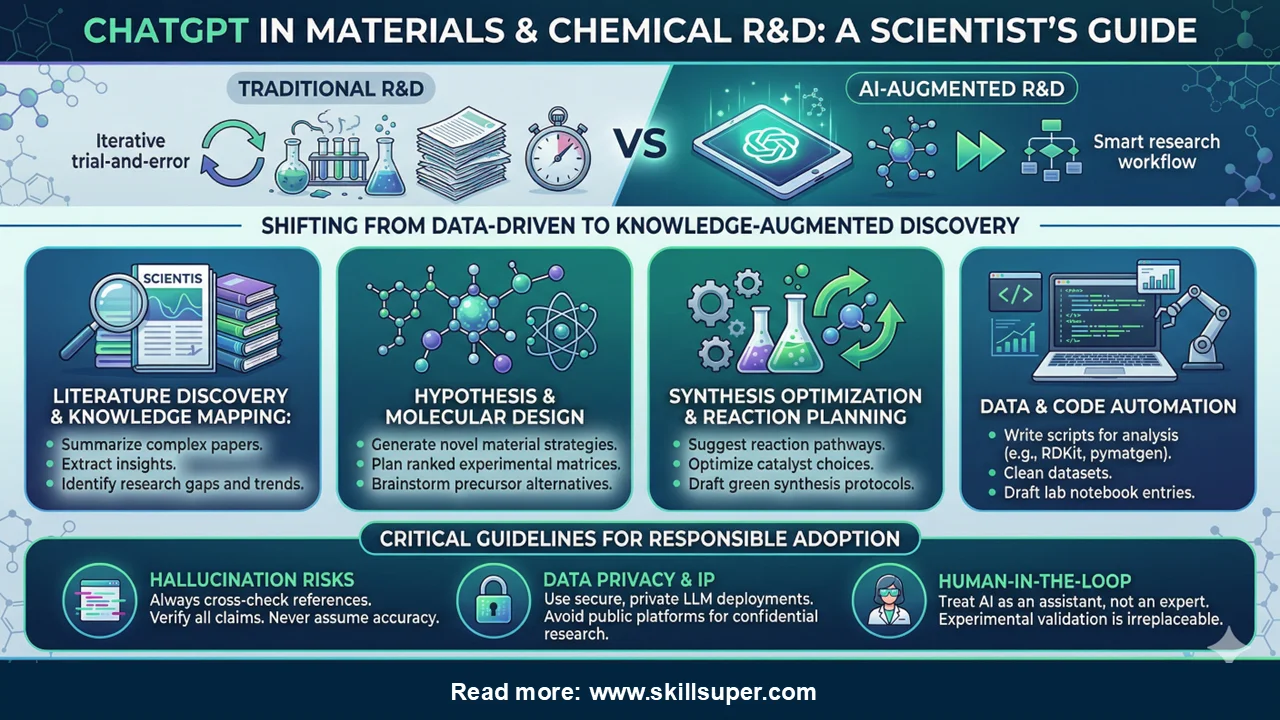
The pace of innovation in materials science and chemical research has historically been constrained by a simple reality: discovery is slow. Traditional R&D relies on iterative trial-and-error, exhaustive literature reviews, and labor-intensive experimental validation. But the landscape is shifting. With the rapid integration of artificial intelligence into scientific workflows, ChatGPT in materials and chemicals R&D is emerging as a transformative force, accelerating hypothesis generation, streamlining data analysis, and redefining how researchers interact with chemical knowledge.
This isn’t about replacing scientists. It’s about augmenting human expertise with conversational AI that can parse decades of published research, draft complex protocols, generate code for molecular modeling, and suggest novel synthetic pathways in seconds. In this comprehensive guide, we’ll explore how large language models (LLMs) like ChatGPT are being applied across the R&D pipeline, the tangible benefits they deliver, the critical limitations researchers must navigate, and what the next decade of AI-augmented chemical discovery will look like.
The Evolution of AI in Materials & Chemical R&D
For decades, computational chemistry and materials informatics operated in silos. Density Functional Theory (DFT) calculations, molecular dynamics simulations, and quantitative structure-property relationship (QSPR) models required specialized expertise, expensive software, and significant compute resources. Machine learning later entered the field, enabling predictive modeling for polymer properties, catalyst performance, and battery electrolyte stability. Yet, adoption remained limited by steep learning curves and fragmented data ecosystems.
Enter generative AI. Unlike traditional predictive models that output numerical values or classifications, LLMs like ChatGPT understand context, follow reasoning chains, and communicate in natural language. This capability bridges the gap between raw computational outputs and human decision-making. Researchers no longer need to write complex queries or master programming frameworks to extract insights. Instead, they can ask questions in plain English, receive structured summaries of peer-reviewed literature, generate Python scripts for data processing, and brainstorm experimental designs that integrate thermodynamic constraints, safety guidelines, and sustainability metrics.
The shift from data-driven to knowledge-augmented R&D is now underway. And ChatGPT sits at the center of this transformation.
How ChatGPT Works in Scientific Research
At its core, ChatGPT is a transformer-based language model trained on vast corpora of text, including scientific papers, patents, textbooks, technical manuals, and open-source code repositories. When applied to materials and chemical research, its utility stems from several key capabilities:
- Natural Language Understanding & Synthesis: ChatGPT can ingest complex chemical nomenclature, material classification systems, and experimental methodologies, then distill them into actionable summaries.
- Code Generation & Automation: It can write Python, R, or MATLAB scripts to interface with chemistry toolkits like RDKit, ASE (Atomic Simulation Environment), or pymatgen, automating tasks like molecular fingerprinting, crystal structure analysis, or reaction yield prediction.
- Protocol Drafting & SOP Generation: Based on published methods or regulatory standards, ChatGPT can generate standardized operating procedures for synthesis, characterization, or safety testing.
- Cross-Domain Knowledge Retrieval: It connects concepts across disciplines, such as linking polymer degradation mechanisms to environmental fate modeling or correlating electrode microstructure with battery cycle life.
- Multilingual Translation & Collaboration: Global R&D teams use it to translate technical documents, standardize terminology, and align multinational projects.
Importantly, ChatGPT does not run quantum calculations or replace laboratory instrumentation. It acts as an intelligent research assistant that accelerates the cognitive and administrative layers of R&D, freeing scientists to focus on experimental validation and breakthrough innovation.
Key Applications in Materials Science & Chemistry
- Accelerating Literature Review & Knowledge Mapping
Traditional literature reviews can take weeks. With ChatGPT, researchers can upload PDFs or paste abstracts and ask targeted questions: “What are the most cited solvent systems for perovskite solar cell fabrication between 2020–2024?” or “Summarize the degradation pathways of polyethylene terephthalate under UV exposure.” The model extracts, compares, and structures findings, often highlighting contradictions or knowledge gaps that warrant further investigation.
- Hypothesis Generation & Experimental Design
ChatGPT excels at ideation. By feeding it constraints like target properties, available precursors, and safety regulations, researchers can generate ranked experimental matrices. For example, a battery materials team might prompt: “Propose three dopant strategies to improve ionic conductivity in garnet-type solid electrolytes, considering cost, stability, and scalability.” The output can include theoretical justifications, expected trade-offs, and references to analogous systems.
- Synthesis Pathway Optimization & Reaction Planning
While dedicated AI retrosynthesis tools exist, ChatGPT serves as a rapid brainstorming companion. It can suggest reaction conditions, catalyst alternatives, green chemistry substitutions, and workup procedures. When integrated with chemical databases via APIs, it becomes a dynamic planning engine that adapts to real-time lab constraints.
- Data Analysis, Visualization & Lab Notebook Integration
Modern labs generate terabytes of spectral, chromatographic, and microscopic data. ChatGPT can help write scripts to clean, normalize, and visualize datasets. It can also draft structured lab notebook entries, auto-generate figure captions, and convert raw results into publication-ready tables. When paired with ELN (Electronic Lab Notebook) platforms, it transforms unstructured notes into searchable, metadata-rich knowledge bases.
- Regulatory Compliance, Safety & Sustainability Reporting
Chemical R&D must navigate REACH, GHS, TSCA, and ESG frameworks. ChatGPT can draft safety data sheets (SDS), assess hazard classifications based on molecular descriptors, and generate sustainability impact summaries. It can also flag potentially restricted substances or suggest bio-based alternatives aligned with circular economy goals.
Real-World Use Cases & Industry Adoption
Leading chemical manufacturers, semiconductor firms, and clean-tech startups are already integrating ChatGPT-like models into their R&D pipelines. While many enterprises use proprietary, fine-tuned versions for IP security, the underlying principles mirror open-access ChatGPT workflows.
- Polymer Development Teams use AI assistants to screen monomer combinations for targeted glass transition temperatures, reducing physical screening cycles by 30–40%.
- Catalyst Research Groups leverage conversational AI to cross-reference kinetic studies, surface science literature, and DFT datasets, accelerating the identification of active site motifs.
- Pharmaceutical Materials Scientists employ ChatGPT to draft patent claims, compare crystalline forms, and generate stability testing protocols aligned with ICH guidelines.
- Battery R&D Labs integrate AI-generated Python workflows to automate impedance spectroscopy data fitting and correlate electrode porosity with rate capability.
These implementations rarely operate in isolation. The most successful deployments embed ChatGPT within secure, internal knowledge graphs that pull from validated databases, instrument logs, and historical experimental records. This ensures outputs are grounded, traceable, and compliant with scientific rigor.
Limitations, Risks & Best Practices for Researchers
Despite its promise, ChatGPT in materials and chemicals R&D is not a black-box oracle. Researchers must navigate several critical limitations:
- Hallucinations & Inaccurate Citations: LLMs can generate plausible-sounding but fabricated references or misstate reaction conditions. Always verify outputs against primary literature or validated databases.
- Training Data Cutoffs & Knowledge Gaps: Models are trained on historical data and may lack awareness of breakthroughs published after their cutoff date.
- Lack of Experimental Grounding: ChatGPT predicts based on textual patterns, not physical laws. It cannot replace thermodynamic calculations or empirical validation.
- Data Privacy & IP Risks: Uploading unpublished formulations, proprietary synthesis routes, or confidential analytical data to public AI platforms can compromise intellectual property.
- Overreliance & Skill Erosion: Excessive dependence on AI for routine tasks may diminish hands-on problem-solving expertise if not balanced with traditional training.
Best Practices for Responsible Adoption:
- Implement a Human-in-the-Loop Workflow: Treat AI outputs as drafts, not final results. Require experimental or computational validation.
- Use Secure, Domain-Specific Deployments: Opt for enterprise-grade or self-hosted LLMs with access controls and audit trails.
- Integrate with Verified Tools: Pair ChatGPT with chemical informatics platforms, spectral databases, and simulation software for ground-truth anchoring.
- Maintain Citation Hygiene: Manually cross-check references. Use AI to find leads, not to cite directly.
- Train Teams on AI Literacy: Educate researchers on prompt engineering, limitation awareness, and ethical usage guidelines.
The Future of AI-Augmented Chemical & Materials R&D
The next frontier lies in multimodal AI systems that combine language, molecular graphs, spectral images, and laboratory robotics. Imagine a closed-loop R&D platform where:
- A researcher describes a target material property in natural language.
- An AI generates candidate structures, predicts stability, and designs synthesis routes.
- Robotic labs execute experiments, feeding real-time data back to the model.
- The system iteratively refines hypotheses, autonomously optimizing formulations.
This vision is already materializing in initiatives like MIT’s “ChemOS,” IBM’s AI-driven catalyst discovery pipelines, and several national lab autonomous experimentation projects. Regulatory bodies are also adapting, with the FDA and EPA exploring AI validation frameworks for chemical safety assessment and materials certification.
For scientists, the skill set will evolve. Proficiency in prompt engineering, data curation, AI model interpretation, and cross-disciplinary collaboration will become as essential as bench techniques or spectroscopy. The researchers who thrive will be those who treat AI not as a shortcut, but as a collaborative partner that amplifies curiosity, creativity, and precision.
Frequently Asked Questions (FAQ)
Q1: Can ChatGPT replace laboratory experiments in materials science?
No. ChatGPT generates hypotheses, drafts protocols, and synthesizes knowledge, but it cannot replicate physical phenomena, measure material properties, or validate theoretical predictions. Experimental verification remains irreplaceable.
Q2: Is ChatGPT accurate enough for chemical synthesis planning?
It can suggest viable pathways and conditions, but outputs should be treated as starting points. Always cross-reference with established literature, safety guidelines, and domain experts before lab execution.
Q3: How do researchers protect IP when using ChatGPT for R&D?
Avoid inputting confidential data into public platforms. Use enterprise-grade AI deployments with encryption, access controls, and data retention policies. Consult legal teams on AI usage agreements and patentability implications.
Q4: What are the best AI tools that integrate ChatGPT capabilities for chemistry?
Popular options include ChemCrow (autonomous chemistry AI), MolGPT, SciSpace, Elicit, and custom pipelines combining OpenAI APIs with RDKit, pymatgen, or ASE. Many labs also fine-tune open-source LLMs like Llama or Mistral on internal chemical corpora.
Q5: Will AI reduce the need for traditional chemists and materials scientists?
AI will shift, not eliminate, roles. Routine documentation, literature screening, and data preprocessing will be automated, while demand will grow for scientists who can design AI workflows, interpret complex outputs, and lead interdisciplinary innovation teams.
Conclusion: Embracing the AI-Augmented Research Paradigm
ChatGPT in materials and chemicals R&D is no longer a futuristic concept—it’s a present-day reality reshaping how discoveries are conceived, designed, and documented. By accelerating literature synthesis, streamlining experimental planning, and democratizing computational workflows, generative AI is compressing innovation cycles that once took years into months.
Yet, the true power of these tools lies not in their ability to replace human expertise, but in their capacity to elevate it. The most successful R&D organizations will be those that integrate AI responsibly: validating outputs rigorously, securing sensitive data, training teams in AI literacy, and maintaining a culture where curiosity and critical thinking remain paramount.
The future of chemical and materials science isn’t human versus machine. It’s human with machine. And for researchers ready to harness this partnership, the next wave of breakthroughs is already within reach.
