
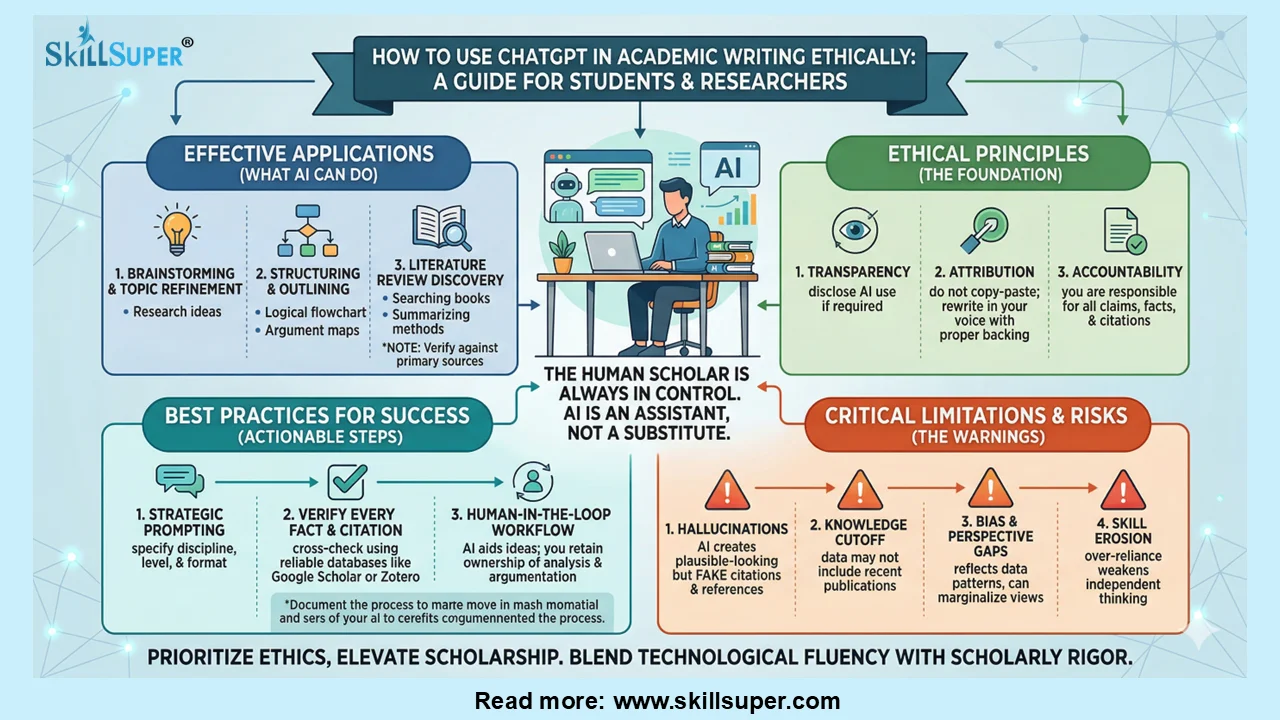
How to Use ChatGPT in Academic Writing Ethically: A Complete Guide for Students & Researchers
The landscape of higher education and scholarly research is undergoing a profound transformation. At the center of this shift is generative artificial intelligence, with ChatGPT emerging as one of the most widely adopted tools across universities worldwide. For students and researchers alike, learning how to use ChatGPT for academic writing ethically has shifted from a novelty to a practical necessity. Yet, the rapid adoption of AI raises critical questions about academic integrity, citation standards, and the balance between efficiency and original thought.
This comprehensive guide explores the real benefits and limitations of AI-assisted scholarship, outlines actionable best practices for AI-assisted academic writing, and provides clear guidance on navigating institutional policies. Whether you’re drafting your first undergraduate essay or refining a peer-reviewed journal submission, understanding ChatGPT academic integrity guidelines for students and researchers will help you harness AI responsibly while preserving scholarly rigor.
The Evolution of AI in Scholarly Work
Before ChatGPT, academic writing support tools were largely limited to grammar checkers, reference managers, and plagiarism detectors. While helpful, these tools operated reactively. Generative AI changed the paradigm by offering proactive, context-aware assistance. Large language models can now analyze prompts, synthesize complex ideas, suggest structural improvements, and even generate drafts in seconds.
However, this convenience comes with a caveat: AI models are trained on vast datasets of publicly available text, not peer-reviewed academic sources. They don’t “understand” research in the human sense; they predict statistically likely sequences of words. Recognizing this fundamental limitation is the first step toward using AI tools for academic writing and citation responsibly.
How ChatGPT Can Enhance Academic Writing
When used strategically, ChatGPT can streamline multiple stages of the writing process. Below are the most effective applications, paired with practical implementation tips.
- Brainstorming & Topic Refinement
Staring at a blank document is a universal academic struggle. ChatGPT excels at generating research angles, narrowing broad topics, and identifying key debates. Try prompts like: “List 5 underexplored research questions about [topic] suitable for a 12-page undergraduate paper.” “Compare theoretical frameworks X and Y in the context of [field].”
- Structuring & Outlining
A strong outline prevents disorganized writing. You can ask ChatGPT to generate discipline-specific outlines, suggest logical transitions, or map out argument flows. Remember: treat AI-generated outlines as starting points, not final blueprints.
- Literature Review Assistance
While ChatGPT cannot access paywalled journals or guarantee up-to-date citations, it can help you:
- Identify seminal authors and foundational theories
- Summarize complex methodologies in plain language
- Suggest search terms for academic databases
- Organize themes into coherent categories
ChatGPT for research paper writing tips consistently emphasize verifying every claim against primary sources. AI should accelerate discovery, not replace it.
- Drafting, Editing & Clarity Enhancement
Many writers use ChatGPT to refine awkward phrasing, adjust tone for academic audiences, or convert bullet notes into cohesive paragraphs. Useful prompts include: “Rewrite this paragraph to improve academic tone and reduce redundancy.” “Check this section for logical flow and suggest improvements.”
Always review AI suggestions critically. Machine-generated prose can sound polished but occasionally lacks disciplinary nuance or misrepresents technical concepts.
Ethical Considerations & Academic Integrity
The debate around benefits and risks of using ChatGPT in university essays centers on transparency, originality, and intellectual ownership. Most institutions distinguish between using AI as a brainstorming/editing tool versus submitting AI-generated text as your own work.
Key Ethical Principles:
- Transparency: Disclose AI use if required by your instructor or journal guidelines.
- Attribution: AI cannot be listed as a co-author. If you quote or paraphrase AI-generated text, treat it as an uncredited source and rewrite it in your own voice with proper scholarly backing.
- Accountability: You remain responsible for every claim, citation, and conclusion in your submission.
- Policy Compliance: Universities are rapidly updating honor codes. Familiarize yourself with your institution’s stance before drafting.
How to avoid plagiarism when using ChatGPT for assignments starts with treating the tool as a research assistant, not a ghostwriter. Never copy-paste AI output without critical evaluation, source verification, and substantial rewriting.
Best Practices for AI-Assisted Academic Writing
To maximize productivity while maintaining scholarly standards, follow these evidence-based strategies:
- Use Prompt Engineering Strategically Vague prompts yield generic responses. Specify discipline, academic level, citation style, and desired output format. Example: “Act as a graduate-level sociology researcher. Draft a 300-word literature review section on digital privacy, using APA 7th edition conventions. Focus on post-2020 studies and highlight methodological gaps.”
- Verify Every Fact & Citation ChatGPT frequently “hallucinates” references—creating plausible-looking but non-existent papers, authors, or DOIs. Always cross-check citations using Google Scholar, your university library database, or reference management software like Zotero or Mendeley.
- Maintain a Human-in-the-Loop Workflow AI should augment, not automate, critical thinking. Use it for ideation, structure, and language refinement, but retain ownership of analysis, argumentation, and synthesis.
- Document Your AI Process Keep a log of prompts used, AI suggestions accepted/rejected, and how you adapted them. This documentation demonstrates academic honesty and can be invaluable if questions arise about your workflow.
- Leverage Discipline-Specific Guidelines Fields like STEM, humanities, and social sciences have different conventions. Tailor AI use accordingly. For example, qualitative research relies heavily on interpretive depth that AI cannot replicate, while quantitative writing may benefit more from statistical explanation drafting.
Limitations & Risks You Must Know
No tool is flawless, and understanding benefits and risks of using ChatGPT in university essays requires honest assessment of its constraints:
- Knowledge Cutoff & Outdated Information: Depending on the version, ChatGPT’s training data may not include recent publications, policy changes, or emerging research trends.
- Bias & Perspective Gaps: AI reflects patterns in its training data, which can amplify dominant viewpoints and marginalize non-Western or interdisciplinary perspectives.
- Over-Reliance & Skill Erosion: Regularly outsourcing outlining, drafting, or editing can weaken your independent writing, critical analysis, and citation skills over time.
- AI Detection Uncertainty: Tools claiming to “detect AI writing” have high false-positive rates. Relying on them for grading or publication decisions remains controversial and academically problematic.
The safest approach treats ChatGPT as a collaborative partner, not a substitute for scholarly rigor.
The Future of AI in Academic Work
Academia is already adapting. Many universities now offer workshops on ChatGPT academic integrity guidelines for students, while journals like Nature and Science have published clear policies on AI disclosure. The consensus is emerging: AI will become embedded in research workflows, but human judgment, ethical oversight, and original scholarship will remain irreplaceable.
Forward-thinking students are learning to:
- Combine AI efficiency with traditional research methodologies
- Develop prompt literacy as a core academic skill
- Advocate for transparent, equitable AI policies on campus
- Use AI to democratize access to writing support, especially for non-native English speakers and first-generation students
As institutions refine guidelines, the focus will shift from “Should we allow AI?” to “How do we teach responsible AI integration?”
Conclusion: Write Smarter, Not Just Faster
ChatGPT has undeniably changed how scholars approach research, drafting, and revision. When used intentionally, it can reduce friction, accelerate ideation, and help writers focus on higher-order thinking. But academic writing is not merely about producing text—it’s about developing arguments, engaging with evidence, and contributing to scholarly conversations. AI cannot replicate curiosity, ethical reasoning, or intellectual ownership.
To thrive in this new landscape, prioritize best practices for AI-assisted academic writing: verify sources, maintain transparency, follow institutional guidelines, and never outsource your critical voice. Mastering how to use ChatGPT for academic writing ethically isn’t about resisting technology; it’s about harnessing it responsibly to elevate your scholarship.
Ready to integrate AI into your workflow without compromising integrity? Start small, document your process, verify every claim, and always keep the human scholar at the center of your work. The future of academic writing belongs to those who blend technological fluency with unwavering scholarly ethics.
