
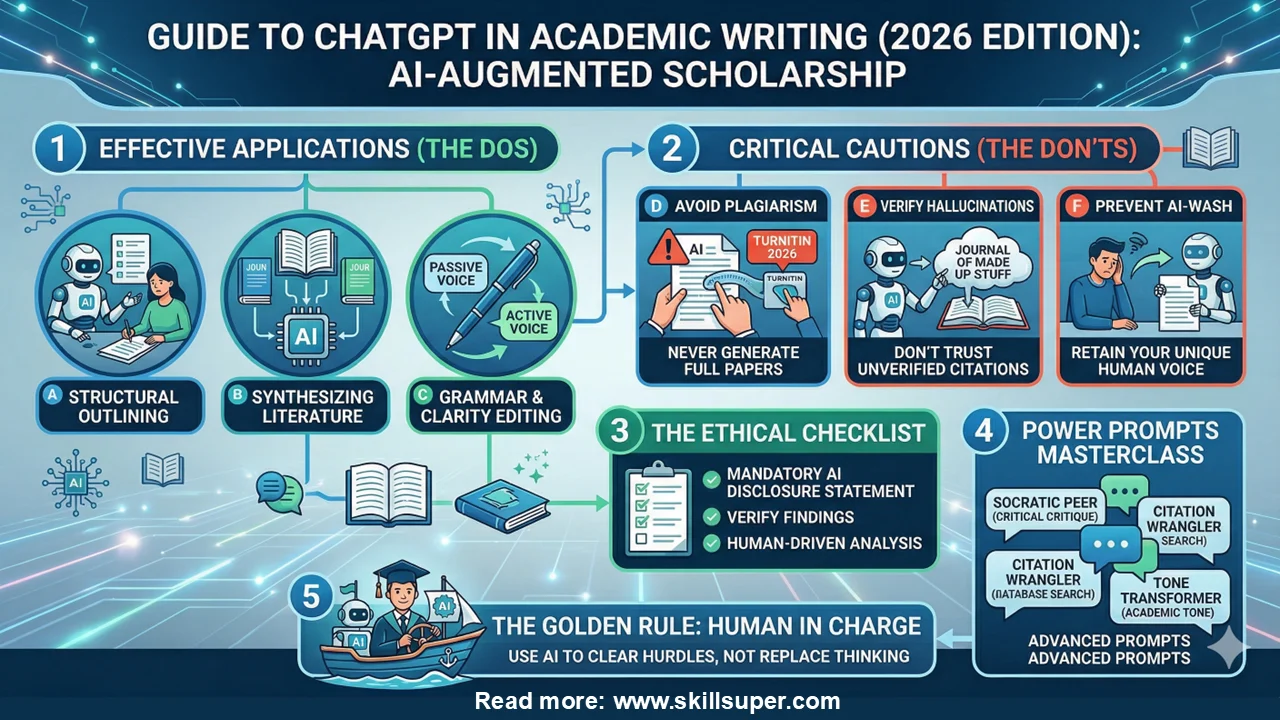
A Comprehensive Guide to Using ChatGPT in Academic Writing (2026 Edition)
In the early 2020s, the mention of “ChatGPT in Academic Writing ” in a lecture hall was often met with gasps of horror or immediate threats of expulsion. Fast forward to 2026, and the landscape has shifted dramatically. We’ve moved past the “Great AI Panic” and entered an era of AI-augmented scholarship. Today, the question isn’t if you should use AI in your research, but how to use it ethically, effectively, and without losing your unique academic voice.
If you’re looking for a way to balance productivity with academic integrity, this guide explores the best practices for leveraging ChatGPT for academic research, navigating the complex ethics of AI-generated content in higher education, and ensuring your work remains authentically yours.
- The Evolution of AI in the Ivory Tower
Only a few years ago, AI was viewed as a glorified autocomplete. Today, models like Gemini 3 and GPT-5 have become sophisticated thought partners. In 2026, university policies have largely pivoted from blanket bans to integrated AI literacy requirements.
The goal of academic writing remains the same: the clear communication of original ideas backed by rigorous evidence. ChatGPT doesn’t replace the scholar; it acts as a high-powered research assistant that never sleeps.
Why Long-Tail Keywords Matter for This Topic
For students and researchers searching for help, the queries have become more specific. We aren’t just searching for “AI writing”; we’re looking for:
- “How to use ChatGPT for systematic literature reviews”
- “Is AI-assisted writing considered plagiarism in 2026?”
- “Prompt engineering for qualitative data analysis”
These specific needs reflect a maturing user base that understands AI is a tool, not a shortcut.
- Practical Applications: Where ChatGPT Shines
Academic writing is a marathon of different tasks. ChatGPT can assist in several key stages of the process without writing the paper for you.
- Structural Outlining and Brainstorming
One of the hardest parts of writing is the blank page. ChatGPT is elite at structural outlining for research papers. By inputting your thesis statement and a list of your primary sources, you can ask the AI to suggest a logical flow.
Pro Tip: Don’t just ask for an outline. Ask: “Compare three different structural approaches for a comparative literature essay on Post-Colonialism.”
- Synthesizing Complex Information
If you’re staring at fifty PDFs for a literature review, ChatGPT can help you synthesize complex academic theories. You can upload (or paste) abstracts and ask the AI to identify common themes, divergent findings, or gaps in the current research.
- Refining Grammar and Stylistic Clarity
Academic writing often falls into the trap of being overly “wordy.” ChatGPT is an excellent editor for improving the readability of academic prose. It can help you transition from passive to active voice or ensure your tone remains consistently formal across a 40-page dissertation.
- The Ethical Minefield: Navigating Integrity in 2026
We have to talk about the elephant in the room: academic integrity. Using AI to generate a full essay and submitting it as your own is—and will likely always be—plagiarism. However, the “gray area” has become much clearer in 2026.
The “Attribution” Standard
Most top-tier journals (like Nature or The Lancet) and universities now require an AI Disclosure Statement. This usually includes:
- Which AI model was used.
- The specific tasks the AI performed (e.g., “AI was used for structural editing and citation formatting”).
- A confirmation that the final ideas and conclusions are the author’s own.
The Problem of Hallucinations
Even in 2026, AI still occasionally “hallucinates”—it can invent citations or misinterpret data. Never trust an AI-generated citation without checking the source yourself. Using ChatGPT to find sources is a great starting point, but “The Journal of Made Up Stuff, 2024” won’t look good on your transcript.
- AI Detection: The Cat-and-Mouse Game
In 2026, the technology for AI content detection has become highly sophisticated, but so has the AI itself. Tools like Turnitin and GPT-Zero now look for more than just “patterns”; they look for “perplexity” and “burstiness”—the natural variations in human writing.
The best way to avoid being flagged by an AI detector is simple: Do the writing yourself.
Use ChatGPT to brainstorm the ideas, organize the data, and edit the flow, but ensure the core drafting comes from your own brain. When you write from your unique perspective, your “voice” carries a signature that AI currently cannot replicate.
- Masterclass: Prompt Engineering for Scholars
To get the most out of ChatGPT, you need to stop asking simple questions and start using context-rich prompts. Here are three “power prompts” for academic writing:
The “Socratic Peer” Prompt
“I am writing a paper on [Topic]. Please act as a critical peer reviewer. Read my following argument and identify three logical fallacies or weak points that an opponent might use to debunk my thesis.”
The “Citation Wrangler” Prompt
“Based on the following summary of my research, suggest five relevant keywords I should use to find peer-reviewed articles in the JSTOR or PubMed databases.”
The “Tone Transformer” Prompt
“The following paragraph is written in a casual tone. Rewrite it to meet the standards of a peer-reviewed sociology journal, ensuring the terminology remains precise and the tone is objective.”
- Managing Citations and Formatting
Formatting is the bane of every researcher’s existence. ChatGPT is a lifesaver for converting citations between styles (APA, MLA, Chicago, Vancouver).
While tools like Zotero and EndNote are still the gold standard for management, ChatGPT can quickly fix a messy bibliography.
- “Convert these five citations from APA 7th edition to Chicago Manual of Style 17th edition.”
Just remember: AI doesn’t have a “live” connection to the physical library stacks. It knows what a citation should look like, but it doesn’t always know if the book actually exists on page 42.
- The Risks of “AI-Wash”
A new phenomenon in 2026 is “AI-Wash,” where academic papers become so polished by AI that they lose their personality. In the humanities especially, the “struggle” with the text is often where the best insights are born. If you let the AI smooth over every rough edge, you might accidentally smooth over your most original (and slightly messy) ideas.
The Golden Rule: If the AI changes a sentence and you don’t fully understand why or what the new words mean, change it back. You are the captain of the ship; the AI is just the engine.
- Summary: Best Practices for AI in Academia
| Step | How to Use ChatGPT | What to Avoid |
| Research | Brainstorming keywords, summarizing long papers. | Relying on AI for factual data or new citations. |
| Outlining | Finding a logical flow for complex arguments. | Let the AI decide your thesis for you. |
| Drafting | Overcoming writer’s block for transition sentences. | Copy-pasting AI text directly into your draft. |
| Editing | Checking for clarity, grammar, and tone consistency. | Losing your “human voice” to over-optimization. |
| Citing | Reformatting styles (APA to MLA). | Assuming the AI-generated citation is real. |
Conclusion: The Future is Collaborative
By 2026, ChatGPT has evolved from a controversial disruptor into a staple of the academic toolkit. It has democratized access to high-level editing and research synthesis, allowing students from all backgrounds to compete on a level playing field of clarity and structure.
However, the “soul” of academia—the critical thinking, the ethical questioning, and the “aha!” moments—remains a purely human endeavor. Use ChatGPT to clear the administrative hurdles of writing so that you can spend more time on what actually matters: thinking.
The students who thrive in this new era won’t be those who hide their use of AI, but those who master it as a partner in their pursuit of knowledge.
Frequently Asked Questions (FAQ)
- Will using ChatGPT result in a plagiarism charge?
It depends on how you use it. Using it to generate ideas or edit your own writing is generally acceptable (if disclosed). Using it to write the entire paper is plagiarism. Always check your specific university’s 2026 AI policy.
- Can ChatGPT read the latest 2026 research papers?
If you have a Pro/Plus subscription with web-browsing capabilities, yes. However, always verify that it isn’t summarizing a “hallucinated” version of a paywalled article.
- What is the best way to cite ChatGPT?
Most styles (APA, MLA) now have specific formats for “Personal Communication” or “Generative AI.” Usually, you cite the prompt you used and the date of the interaction.
- Does AI help with qualitative data analysis?
Yes, it can help categorize themes in interview transcripts, but it cannot replace the “reflexivity” or deep cultural context a human researcher provides.
How are you currently integrating AI into your research workflow, and have you found any specific prompts that consistently deliver high-quality academic results?
