
ChatGPT in Innovation and Development: How AI is Reshaping the Future of Tech
The pace of technological innovation has never been faster, and at the center of this acceleration is a tool that has fundamentally altered how teams think, build, and iterate: ChatGPT. What began as a conversational AI experiment has rapidly evolved into a cornerstone of modern innovation and development workflows. From ideation and rapid prototyping to code generation, testing, and product strategy, ChatGPT is no longer just a novelty—it’s a catalyst.
In this comprehensive guide, we’ll explore how ChatGPT is transforming innovation pipelines, accelerating software development, bridging cross-functional gaps, and redefining what’s possible in tech creation. We’ll also address the practical challenges, ethical considerations, and proven strategies for integrating AI responsibly into your development process.
From Conversational AI to Co-Creator: Why ChatGPT Matters for Innovation
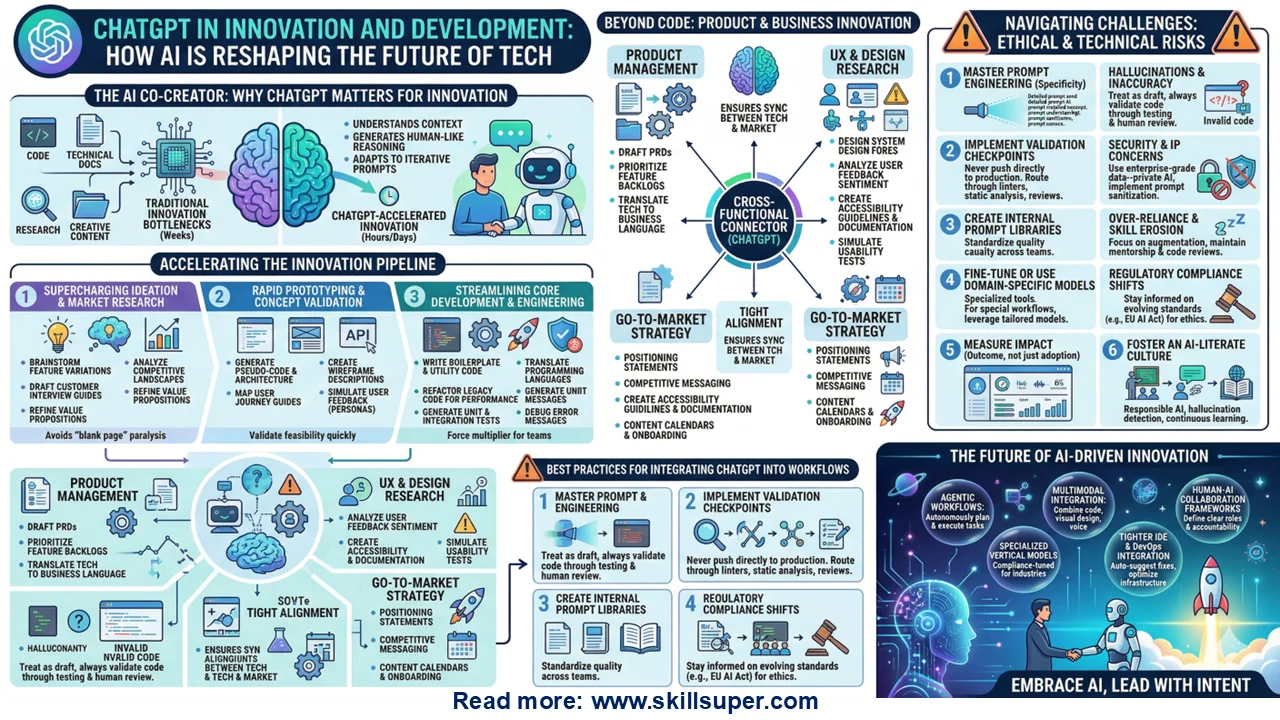
ChatGPT, developed by OpenAI, is built on large language model (LLM) architecture trained on vast datasets spanning code, technical documentation, scientific research, business frameworks, and creative content. Unlike rule-based systems or narrow AI, ChatGPT understands context, generates human-like reasoning, and adapts to iterative prompts. This makes it uniquely suited for innovation, a domain that thrives on exploration, iteration, and cross-disciplinary synthesis.
In traditional innovation cycles, bottlenecks often emerge during research, prototyping, and technical validation. Teams spend weeks gathering insights, drafting specifications, or writing baseline code. ChatGPT compresses these timelines by acting as an on-demand collaborator: a brainstorming partner, a technical translator, a documentation assistant, and a rapid prototyping engine. The result? Shorter feedback loops, lower barrier to entry for non-technical innovators, and a democratization of creative problem-solving.
How ChatGPT Accelerates the Innovation Pipeline
Innovation isn’t a single event; it’s a structured process. ChatGPT enhances every stage of the pipeline, from initial concept to market-ready product.
Supercharging Ideation & Market Research
Early-stage innovation requires divergent thinking. ChatGPT excels at generating multiple perspectives, identifying market gaps, and synthesizing trends from disparate industries. Product managers and founders use it to:
- Brainstorm feature variations based on user pain points
- Analyze competitive landscapes through structured comparison matrices
- Draft customer interview guides and survey frameworks
- Simulate stakeholder objections and refine value propositions
By providing instant, context-aware ideation, ChatGPT reduces the “blank page” paralysis that often stalls early innovation phases.
Rapid Prototyping & Concept Validation
Moving from idea to tangible prototype traditionally requires design, engineering, and user testing resources. ChatGPT bridges this gap by generating:
- Pseudo-code and architectural outlines
- API integration strategies and data flow diagrams
- Wireframe descriptions and user journey maps
- Simulated user feedback based on target personas
Teams can validate feasibility in hours rather than weeks, allowing them to fail fast, iterate quickly, and allocate resources only to concepts with proven traction.
Streamlining Core Development & Engineering
Once an idea moves into development, ChatGPT becomes a force multiplier for engineering teams. It assists with:
- Writing boilerplate code, utility functions, and configuration files
- Translating between programming languages (e.g., Python to TypeScript)
- Refactoring legacy code for performance and readability
- Generating unit tests, integration tests, and CI/CD pipeline scripts
- Explaining complex algorithms or debugging cryptic error messages
While ChatGPT doesn’t replace senior engineers, it dramatically reduces cognitive load, accelerates onboarding, and frees developers to focus on architecture, optimization, and creative problem-solving.
Beyond Code: ChatGPT’s Role in Product & Business Innovation
Software development is only one piece of the innovation puzzle. Modern products succeed when engineering, design, marketing, and operations align. ChatGPT serves as a cross-functional connector, enabling non-technical stakeholders to participate meaningfully in the development lifecycle.
Product Management: AI helps draft PRDs (Product Requirements Documents), prioritize feature backlogs using RICE or MoSCoW frameworks, and translate technical constraints into business language.
UX & Design Research: Designers use ChatGPT to analyze user feedback sentiment, generate accessibility guidelines, create design system documentation, and simulate usability test scenarios.
Go-to-Market Strategy: Marketing and sales teams leverage AI for positioning statements, competitive messaging, content calendars, and customer onboarding flows. Because ChatGPT understands both technical and commercial contexts, it ensures that product development and market rollout stay tightly synchronized.
This alignment is critical. Innovation fails not when technology underperforms, but when it solves the wrong problem or launches without a clear adoption strategy. ChatGPT helps bridge that gap by making technical processes transparent and business processes data-informed.
Navigating the Challenges: Ethics, Accuracy & Implementation Risks
No transformative tool is without limitations. To harness ChatGPT effectively in innovation and development, teams must acknowledge and mitigate its inherent risks.
Hallucinations & Factual Inaccuracy
LLMs generate plausible-sounding responses, not verified truths. Code snippets may contain deprecated libraries; architectural suggestions might ignore scalability constraints; market analyses could rely on outdated training data. Best practice: Treat AI output as a draft, not a deliverable. Always validate code through testing, cross-reference technical claims, and maintain human review gates.
Security & Intellectual Property Concerns
Pasting proprietary code, customer data, or unreleased product specs into public AI models poses compliance and IP risks. Many organizations mitigate this by:
- Using enterprise-grade, data-private AI deployments
- Implementing prompt sanitization and data redaction protocols
- Leveraging open-source or fine-tuned models hosted on secure infrastructure
Over-Reliance & Skill Erosion
When developers lean too heavily on AI for routine tasks, foundational skills can atrophy. Junior engineers might miss learning opportunities; senior architects might outsource critical thinking. The goal isn’t automation—it’s augmentation. Maintain mentorship, code reviews, and continuous learning alongside AI integration.
Regulatory & Compliance Shifts
As AI-generated content and code become commonplace, industries are drafting new guidelines around disclosure, liability, and auditability. Stay informed on evolving standards (e.g., EU AI Act, NIST AI RMF) to ensure your innovation pipeline remains compliant and ethically sound.
Best Practices for Integrating ChatGPT into Development Workflows
Successful AI adoption requires intentional design. Here’s how high-performing teams embed ChatGPT into innovation and development without compromising quality or security:
- Master Prompt Engineering: Specificity yields accuracy. Instead of “Write a login function,” try “Generate a secure Express.js login route with JWT, rate limiting, input validation, and error handling. Include comments explaining security considerations.”
- Implement Validation Checkpoints: Never push AI-generated code directly to production. Route it through linters, static analysis, peer review, and automated testing suites.
- Create Internal Prompt Libraries: Document high-performing prompts for common tasks (code refactoring, API documentation, test generation, architecture review) to standardize quality across teams.
- Fine-Tune or Use Domain-Specific Models: For specialized workflows (medical tech, fintech, aerospace), general-purpose LLMs may lack precision. Consider fine-tuned models or retrieval-augmented generation (RAG) pipelines trained on internal documentation and industry standards.
- Measure Impact, Not Just Adoption: Track metrics like cycle time reduction, defect rate, documentation completeness, and developer satisfaction. AI should improve outcomes, not just add tools to the stack.
- Foster an AI-Literate Culture: Train teams on responsible AI use, hallucination detection, prompt iteration, and ethical boundaries. Innovation thrives when everyone understands both the power and the limits of the technology.
The Future of AI-Driven Innovation & Development
ChatGPT is just the beginning. The next wave of AI-assisted development will be defined by:
- Agentic Workflows: AI systems that don’t just respond to prompts but autonomously plan, execute, and iterate across multiple tools (IDEs, version control, cloud consoles, testing frameworks).
- Multimodal Integration: Combining code generation with visual design, voice interfaces, and real-time data streams to create end-to-end development environments.
- Specialized Vertical Models: Industry-tuned LLMs optimized for healthcare compliance, financial regulations, embedded systems, or game engine optimization.
- Tighter IDE & DevOps Integration: AI baked directly into CI/CD pipelines, automatically suggesting fixes, optimizing cloud costs, and generating deployment rollbacks.
- Human-AI Collaboration Frameworks: Standardized methodologies that define clear boundaries between AI generation and human oversight, ensuring accountability while maximizing velocity.
The companies that win in the next decade won’t be those with the most AI—they’ll be those with the best AI integration strategies. Innovation will increasingly reward teams that combine human creativity, domain expertise, and disciplined AI augmentation.
Conclusion: Embrace AI, But Lead with Intent
ChatGPT in innovation and development isn’t about replacing engineers, designers, or product leaders. It’s about removing friction, accelerating learning, and unlocking creative capacity that was previously bottlenecked by time, resources, or technical debt. When used thoughtfully, AI becomes a force multiplier: turning weeks into days, reducing burnout, and enabling teams to tackle more ambitious problems.
The future belongs to innovators who experiment responsibly, validate rigorously, and keep human judgment at the center of every AI-assisted decision. Start small: integrate ChatGPT into one workflow, measure the impact, refine your prompts, and scale what works. The tools will evolve rapidly, but the principles of thoughtful adoption, ethical implementation, and human-centered design will remain timeless.
