
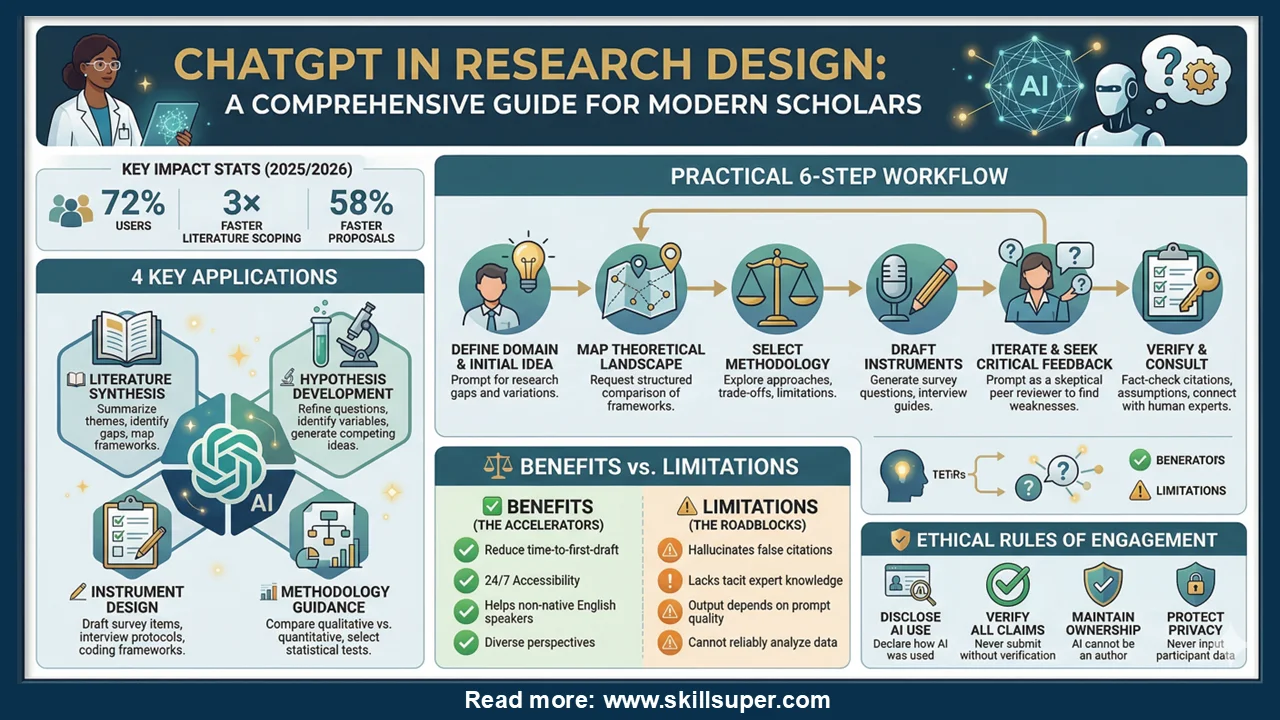
ChatGPT in Research Design: A Comprehensive Guide for Modern Scholars
- Posted by Medhat Zohery
- Date April 13, 2026
- Categories AI in Academia and R&D
From formulating research questions to synthesizing literature, ChatGPT is redefining what it means to design rigorous, high-quality research. Here is everything you need to know about integrating this powerful AI into your research workflow — responsibly and effectively.
- What Is ChatGPT and Why Does It Matter for Research?
- How ChatGPT Fits Into the Research Design Process
- Key Applications: From Literature Review to Data Analysis
- Practical Step-by-Step Workflow
- Benefits and Limitations
- Ethical Considerations for Researchers
- The Future of AI-Assisted Research Design
- Conclusion
What Is ChatGPT and Why Does It Matter for Research?
ChatGPT, developed by OpenAI, is a large language model (LLM) capable of understanding and generating human-like text across virtually any domain. Built on the GPT architecture and trained on vast corpora of scientific, academic, and general-purpose text, ChatGPT can engage in nuanced dialogue, synthesize complex information, generate structured content, and assist with analytical tasks — making it an extraordinarily versatile tool for academic and scientific research.
The relevance of ChatGPT in research design is not merely about convenience. It represents a fundamental shift in how researchers interact with knowledge. Traditionally, research design — the blueprint that guides an entire study — has demanded months of deliberation, iterative reading, and expert consultation. ChatGPT compresses many of these cycles, allowing researchers to rapidly prototype ideas, stress-test assumptions, and receive structured feedback on their methodological choices.
How ChatGPT Fits Into the Research Design Process
Research design is the overarching strategy that aligns your research questions, methodology, data collection methods, and analytical framework. It is typically broken into several critical phases: conceptualization, literature review, hypothesis formulation, methodology selection, instrument development, data collection, analysis, and reporting. ChatGPT can meaningfully contribute to nearly every one of these stages.
Understanding where AI fits — and where it does not — is essential. ChatGPT excels at accelerating cognitive tasks that involve language, synthesis, and structure. It is not a database, cannot access real-time literature (unless connected to external tools), and cannot replace the critical judgment that expert researchers bring to interpreting findings. Used strategically, however, it functions as a highly competent research collaborator available around the clock.
Think of ChatGPT not as a replacement for your expertise, but as a tireless intellectual sparring partner — one that can rapidly surface connections, challenge your assumptions, and draft preliminary text that you refine with domain knowledge.
Key Applications: From Literature Review to Data Analysis
1. Conceptualizing and Refining Research Questions
One of the most challenging early steps in any study is sharpening the research question. A poorly defined question leads to unfocused data collection and uninterpretable results. ChatGPT can help by generating multiple alternative framings of a research question, identifying implicit assumptions embedded in the wording, and aligning the question with established theoretical frameworks. By prompting ChatGPT with your initial idea and asking it to produce five variations across different epistemological stances — positivist, interpretivist, critical — researchers can rapidly develop conceptual clarity that might otherwise take weeks.
2. Accelerating Literature Reviews
Literature review is foundational to research design because it situates your study within existing knowledge. While ChatGPT does not replace dedicated database searches (PubMed, Web of Science, Scopus), it is invaluable for organizing and synthesizing material you have already gathered. Paste in abstracts or excerpts and ask ChatGPT to identify recurring themes, unresolved debates, or methodological trends. It can produce thematic matrices, compare theoretical models side-by-side, and draft narrative summaries that serve as the basis for your written review.
Importantly, researchers must verify all citations and factual claims independently. ChatGPT can occasionally produce plausible-sounding but inaccurate references — a phenomenon known as "hallucination." Using it to synthesize structure and argument rather than as a source of references mitigates this risk substantially.
3. Methodology Selection and Justification
Choosing between a randomized controlled trial, a grounded theory approach, or a cross-sectional survey involves trade-offs that depend on your epistemological stance, resource constraints, and research question. ChatGPT can walk researchers through these trade-offs systematically, presenting the philosophical underpinnings of each methodology, common criticisms, and examples from published research. For graduate students new to research design, this capability alone can significantly shorten the learning curve.
4. Developing Research Instruments
Survey design, interview protocol development, and observation checklists require careful attention to construct validity — ensuring the instrument measures what it is intended to measure. ChatGPT can generate initial item banks for surveys based on validated scales you describe, suggest Likert scale formats, propose open-ended probes for qualitative interviews, and even offer feedback on existing drafts by identifying double-barreled questions, leading language, or ambiguous phrasing. This substantially accelerates the iterative process of instrument refinement before piloting.
5. Writing and Structuring Research Proposals
A well-structured research proposal communicates scientific merit and practical feasibility to funding bodies or ethics committees. ChatGPT can produce detailed outlines for proposal sections — background, rationale, objectives, methodology, timeline, and budget justification narratives — based on minimal input. While the intellectual substance must come from the researcher, the structural scaffolding ChatGPT provides dramatically reduces the blank-page problem and accelerates the drafting process.
Practical Step-by-Step Workflow
Benefits and Limitations
- Dramatically reduces time-to-first-draft across all research phases
- Accessible 24/7, lowering barriers for under-resourced researchers
- Supports iterative refinement through natural dialogue
- Helps non-native English speakers with academic writing
- Generates diverse perspectives to stress-test your reasoning
- Explains unfamiliar methodologies across disciplines
- Cannot access current literature without plugin integration
- Prone to hallucinating plausible-sounding false citations
- Lacks domain-specific tacit knowledge of expert researchers
- May reflect biases present in training data
- Output quality depends heavily on prompt quality
- Cannot perform original empirical data analysis reliably
Ethical Considerations for Researchers
The integration of ChatGPT into research design raises substantive ethical questions that the scholarly community is actively debating. Transparency, attribution, and academic integrity are the three pillars around which responsible use must be organized.
Many professional organizations, including the American Psychological Association and the Committee on Publication Ethics (COPE), have affirmed that AI cannot be listed as a co-author, as authorship requires accountability — something AI systems cannot bear.
The Future of AI-Assisted Research Design
The trajectory is clear: AI-assisted research will become the norm rather than the exception. Emerging developments include multimodal models capable of analyzing charts, images, and raw data files; specialized research assistants fine-tuned on discipline-specific corpora; and AI systems integrated directly into institutional research management platforms.
Perhaps more significantly, AI is beginning to influence the epistemological foundations of research itself. When machine learning models can identify patterns in data that human researchers would not think to look for, the boundary between hypothesis generation and data-driven discovery blurs. Researchers who understand how to harness these capabilities thoughtfully — while preserving the rigorous standards of scientific inquiry — will be disproportionately productive and impactful.
Graduate training programs, research ethics boards, and funding agencies are all adapting their frameworks. Courses in "AI-augmented research methods" are appearing in curricula at leading universities. The researchers who will thrive in this environment are those who develop sophisticated AI literacy — the ability to prompt effectively, evaluate output critically, and integrate AI tools within a robust methodological framework.
Conclusion
ChatGPT is not a magic wand that produces research designs on demand — but it is a remarkably powerful accelerant for researchers who bring genuine expertise and critical thinking to the table. Used thoughtfully, it compresses the time required for conceptualization, literature scoping, methodology selection, and instrument development. Used carelessly, it can introduce errors, obscure intellectual accountability, and produce the illusion of rigor without its substance.
The most productive approach treats ChatGPT as a brilliant but fallible collaborator: one whose contributions must always be reviewed, verified, and ultimately shaped by your own scholarly judgment. Whether you are designing your first undergraduate study or your tenth funded research program, integrating ChatGPT strategically into your workflow is no longer an option to consider — it is a skill to develop.
Keywords: ChatGPT in research design, AI for academic research, large language models research methodology, ChatGPT literature review, AI research tools, generative AI in science, ChatGPT ethics research, research design methodology 2026
