
ChatGPT as a Search Engine and Digital Library: The Future of Information Retrieval
Introduction: The End of the Ten Blue Links?
For over two decades, finding information online meant typing keywords into a search bar, sifting through dozens of links, and manually extracting what you needed. That era is rapidly fading. Enter ChatGPT: an artificial intelligence system that doesn’t just point you to information—it reads, synthesizes, and converses with you about it. Today, professionals, students, and casual learners are increasingly treating ChatGPT as a search engine and digital library, a shift that’s fundamentally changing how we discover, verify, and apply knowledge.
But is ChatGPT truly replacing traditional search engines? Can it function as a reliable academic or professional library? In this comprehensive guide, we’ll explore how ChatGPT works as an information retrieval tool, compare it to conventional search methods, outline its strengths and limitations, and provide actionable best practices for leveraging AI-powered research responsibly.
What Is ChatGPT, Really? Beyond the Chatbot Hype
ChatGPT is a large language model (LLM) developed by OpenAI, trained on a massive corpus of text from books, websites, academic papers, code repositories, and more. Unlike rule-based systems, it predicts the most contextually appropriate response based on patterns learned during training. Crucially, it doesn’t “know” facts in the human sense—it generates statistically probable answers based on linguistic structure and semantic relationships.
While early versions operated in a static, pre-2021 knowledge window, modern iterations integrate real-time web browsing, file uploads, and API-driven data sources. This evolution has transformed ChatGPT from a conversational novelty into a dynamic AI knowledge base capable of summarizing literature, drafting research frameworks, answering technical questions, and simulating library-style reference services.
ChatGPT vs. Traditional Search Engines: A Paradigm Shift
To understand why ChatGPT is being adopted as an alternative search and research tool, we must first examine how it differs from conventional engines like Google, Bing, or DuckDuckGo.
How Traditional Search Engines Work
Traditional search engines rely on web crawlers, indexing algorithms, and ranking signals (backlinks, page authority, user behavior). When you search, you receive a list of hyperlinks. The engine doesn’t read or interpret the content for you—it simply surfaces pages that match your query. You become the researcher: clicking, scanning, cross-referencing, and synthesizing.
How ChatGPT Approaches Information Retrieval
ChatGPT operates on semantic understanding and generative synthesis. Instead of returning links, it interprets your natural language prompt, retrieves relevant patterns from its training data (and optionally live web sources), and constructs a direct, contextualized response. You can ask follow-up questions, request citations, adjust tone, or ask for comparisons—all within a single conversational thread.
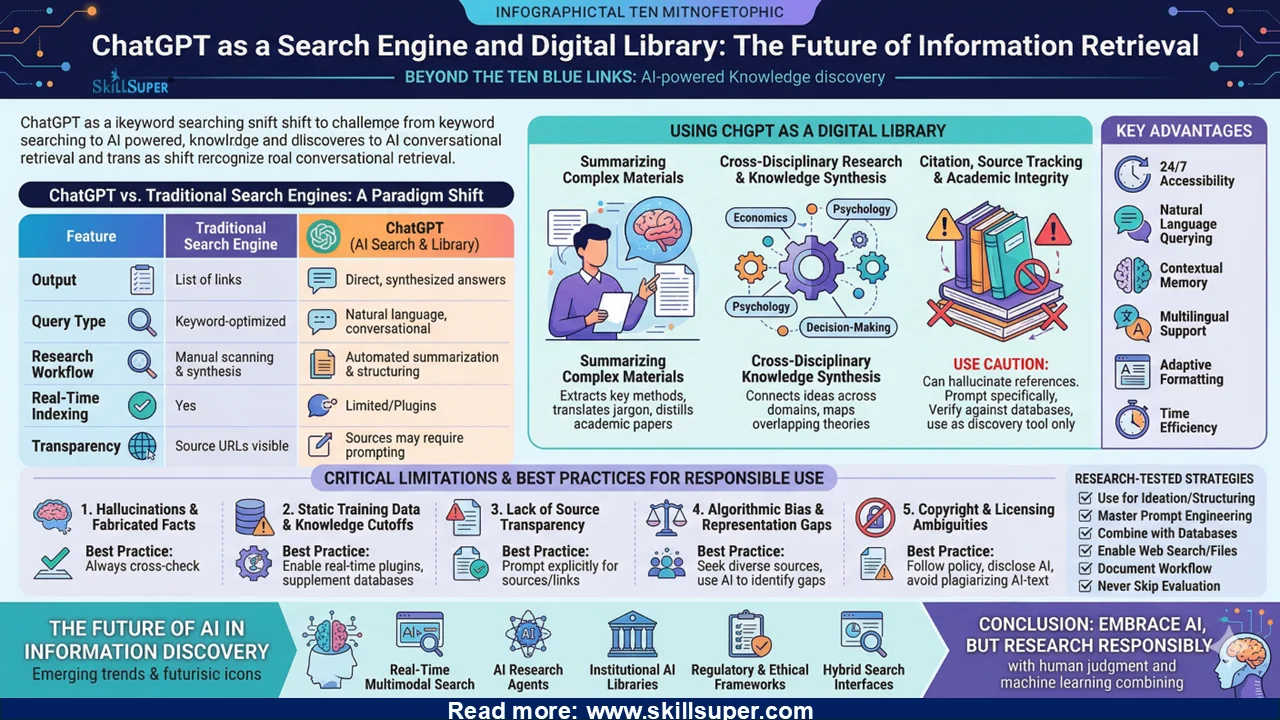
| Feature | Traditional Search Engine | ChatGPT (AI Search & Library) |
| Output | List of links + snippets | Direct, synthesized answers |
| Query Type | Keyword-optimized | Natural language, conversational |
| Research Workflow | Manual scanning & synthesis | Automated summarization & structuring |
| Real-Time Indexing | Yes | Limited (depends on version/plugins) |
| Transparency | Source URLs visible | Sources may require explicit prompting |
This shift doesn’t mean traditional search is obsolete. Instead, AI search complements it, acting as a first-pass research assistant that accelerates discovery before you dive into primary sources.
Using ChatGPT as a Digital Library
A traditional library organizes, preserves, and provides access to curated knowledge. ChatGPT mimics this function in a highly interactive, on-demand format. Here’s how it functions as a modern digital library:
Summarizing Complex Materials
Upload a PDF, paste a research abstract, or ask ChatGPT to explain quantum entanglement, Keynesian economics, or CRISPR gene editing in plain language. It can distill dense academic papers into executive summaries, extract key methodologies, or translate jargon into accessible concepts. For students and professionals, this dramatically reduces cognitive load during literature reviews.
Cross-Disciplinary Research & Knowledge Synthesis
Libraries excel at connecting ideas across domains. ChatGPT does this inherently. Ask it to “compare how behavioral economics and cognitive psychology approach decision-making under uncertainty,” and it will map overlapping theories, cite foundational researchers, and highlight divergent methodologies. This interdisciplinary synthesis is notoriously time-consuming manually but takes seconds with AI.
Citation, Source Tracking & Academic Integrity
Here’s where caution is essential. ChatGPT can generate realistic-looking citations, but it frequently hallucinates references or mixes real papers with fabricated titles, authors, or DOIs. Responsible use requires:
- Prompting: “Only cite peer-reviewed sources published before [year]. Provide DOIs or URLs.”
- Verifying every reference against Google Scholar, PubMed, or institutional databases.
- Using AI as a discovery tool, not a citation authority.
Many universities now publish AI usage guidelines emphasizing that ChatGPT should aid research design, not replace source verification.
Key Advantages of AI-Powered Search & Library Tools
Why are millions turning to ChatGPT for information retrieval? The benefits are substantial when used intentionally:
✅ 24/7 Accessibility & Instant Responses – No waiting for interlibrary loans, paywall restrictions, or human librarians.
✅ Natural Language Querying – Ask questions exactly as you’d speak them. No need to master Boolean operators or search syntax.
✅ Contextual Memory – Follow-up questions retain conversation history, enabling iterative research refinement.
✅ Multilingual Support – Query and receive responses in dozens of languages, breaking down academic and geographic barriers.
✅ Adaptive Formatting – Request tables, bullet points, markdown, code, or presentation outlines tailored to your workflow.
✅ Time Efficiency – Reduce hours of manual scanning to minutes of targeted synthesis.
For educators, developers, marketers, and researchers, these advantages translate into faster ideation, cleaner literature reviews, and more structured project planning.
Critical Limitations & How to Navigate Them
Despite its impressive capabilities, ChatGPT is not a flawless repository of truth. Understanding its constraints is non-negotiable for serious research.
- Hallucinations & Fabricated Facts
LLMs prioritize fluency over factual accuracy. They can confidently state incorrect dates, misattribute quotes, or invent studies. Mitigation: Always cross-check claims with authoritative sources. Treat AI outputs as hypotheses, not conclusions.
- Static Training Data & Knowledge Cutoffs
Unless using web-browsing features, ChatGPT’s knowledge is frozen at its last training update. It won’t know about events, publications, or policy changes that occurred afterward. Mitigation: Enable real-time search plugins, specify date ranges in prompts, or supplement with current academic databases.
- Lack of Source Transparency
Traditional search engines show you exactly where information comes from. ChatGPT blends sources into a single response, making provenance tracking difficult. Mitigation: Prompt explicitly: “List your sources with direct links. Flag any uncertain claims.”
- Algorithmic Bias & Representation Gaps
Training data reflects historical publishing trends, which overrepresent Western, English-language, and male-authored content. Marginalized voices, non-English research, and grassroots knowledge may be underrepresented. Mitigation: Actively seek diverse sources, use AI to identify gaps in your research, and consult specialized archives.
- Copyright & Licensing Ambiguities
AI models are trained on publicly available text, but repurposing that output for commercial or academic work raises ethical and legal questions. Mitigation: Follow your institution’s AI policy, disclose AI assistance, and avoid passing off AI-generated text as original scholarship.
Best Practices for Researchers, Students & Professionals
To harness ChatGPT as a reliable search engine and digital library, adopt these research-tested strategies:
- Use It for Ideation & Structuring, Not Final Facts – Ask ChatGPT to generate research questions, outline literature reviews, or suggest methodologies. Verify all substantive claims independently.
- Master Prompt Engineering – Be specific: “Summarize the 2023 IPCC report’s section on renewable energy transition, focusing on economic barriers. Provide 3 peer-reviewed sources published after 2020.”
- Combine AI with Traditional Databases – Use ChatGPT to navigate complex topics, then transition to JSTOR, PubMed, IEEE Xplore, or your university library for primary sources.
- Enable Web Search & File Upload Features – When accuracy matters, activate real-time browsing or upload PDFs so the AI grounds responses in your actual documents.
- Document Your AI Workflow – Keep a research log noting prompts used, AI outputs, and verified sources. This ensures reproducibility and academic transparency.
- Never Skip Critical Evaluation – Ask yourself: Does this align with established literature? Is the methodology sound? Are sources traceable? AI accelerates research; it doesn’t replace scholarly rigor.
The Future of AI in Information Discovery
ChatGPT’s role as a search engine and digital library is only beginning. Emerging trends point to a more integrated, ethical, and precise AI research ecosystem:
🔹 Real-Time Multimodal Search – Future models will seamlessly combine text, images, audio, and video, allowing users to “search” across media types conversationally.
🔹 AI Research Agents – Autonomous AI assistants will draft literature reviews, track citation networks, and alert users to new publications in their field.
🔹 Institutional AI Libraries – Universities and corporations are building private, curated AI knowledge bases trained on verified, licensed content to eliminate hallucination risks.
🔹 Regulatory & Ethical Frameworks – Governments and academic bodies are developing standards for AI citation, data provenance, and algorithmic transparency in scholarly work.
🔹 Hybrid Search Interfaces – Next-generation platforms will blend traditional SERPs with AI synthesis, giving users both source transparency and conversational efficiency.
The goal isn’t to replace human judgment but to augment it. AI won’t eliminate libraries or search engines; it will transform them into collaborative, intelligent ecosystems.
Frequently Asked Questions (FAQ)
Q: Can ChatGPT replace Google for everyday searches?
A: For quick answers, explanations, or brainstorming, yes. For real-time news, local information, or source-verified research, traditional search remains more reliable. Use both strategically.
Q: Is ChatGPT accurate enough for academic research?
A: It’s excellent for structuring research, identifying concepts, and drafting outlines, but never for unverified facts or citations. Always cross-reference with peer-reviewed databases.
Q: How do I stop ChatGPT from making up sources?
A: Prompt: “Only use verifiable sources. If unsure, say ‘I cannot confirm this.’ Provide direct URLs or DOIs.” Enable web search when available, and manually verify every reference.
Q: Does ChatGPT store my research queries?
A: OpenAI states that chat data may be reviewed for safety and improvement unless you opt out in privacy settings. Avoid sharing sensitive, proprietary, or unpublished research.
Q: Will AI search engines make librarians obsolete?
A: No. Librarians are evolving into AI literacy educators, data curators, and research strategy guides. Human expertise in information ethics, source evaluation, and scholarly communication remains irreplaceable.
Conclusion: Embrace AI, But Research Responsibly
ChatGPT has undeniably redefined how we interact with information. Functioning as both an intelligent search engine and a conversational digital library, it democratizes access to knowledge, accelerates discovery, and lowers the barrier to complex research. Yet, it is not a substitute for critical thinking, source verification, or academic integrity.
The most successful researchers of tomorrow won’t be those who abandon traditional tools or blindly trust AI. They’ll be the ones who combine the speed of machine learning with the rigor of human scholarship. Use ChatGPT to ask better questions, explore new connections, and structure your workflow. Then, verify, cite, and think independently.
Information is no longer just found—it’s conversed with, synthesized, and co-created. As AI continues to evolve, staying informed, ethical, and critically engaged will be your greatest research advantage.
