
The Ultimate Guide to Using ChatGPT for Academic Editing and Proofreading
The landscape of academic publishing is notoriously rigorous, demanding, and highly competitive. For researchers, scientists, and graduate students, conducting groundbreaking research is only half the battle; the other half is communicating those findings with absolute clarity, precision, and adherence to strict academic conventions. Historically, this has meant spending countless hours agonizing over sentence structures, hiring expensive professional editors, or relying on overwhelmed colleagues for a quick review.
Enter artificial intelligence. In recent years, the integration of large language models into daily workflows has transformed how we approach text, and academia is no exception. Using ChatGPT for academic editing and proofreading has quickly shifted from a novel experiment to an essential productivity hack for scholars worldwide.
But can a machine truly understand the nuanced jargon of quantum physics, the complex theoretical frameworks of sociology, or the rigid formatting requirements of an APA dissertation? The answer is a resounding “yes, but with caveats.”
In this comprehensive guide, we will explore the ins and outs of using ChatGPT for academic editing and proofreading. We will cover the profound benefits, the actionable strategies for getting the best results, the unavoidable limitations, and the ethical considerations you must keep in mind before submitting your manuscript to a peer-reviewed journal.
To understand why ChatGPT is so effective at manipulating text, it helps to look at how it functions. ChatGPT is built on a Large Language Model (LLM) architecture. It has been trained on a massive corpus of text derived from the internet, which includes millions of books, articles, and, crucially, academic papers across virtually every discipline.
Because of this vast training data, ChatGPT inherently understands the “shape” and “sound” of academic writing. It recognizes the formal tone required for a literature review, the concise language needed for a methodology section, and the persuasive logic expected in a discussion chapter.
When you are using ChatGPT for academic editing and proofreading, you are essentially tapping into a vast statistical engine that predicts the most logical, grammatically correct, and contextually appropriate sequence of words. It does not “think” like a human editor, but its pattern recognition capabilities allow it to spot grammatical inconsistencies, awkward phrasing, and structural flaws with astonishing speed.
The Core Benefits of Using ChatGPT for Academic Editing and Proofreading
The adoption of AI in scholarly writing is not just a trend; it solves fundamental pain points that researchers have faced for decades. Here is why scholars are increasingly turning to AI.
- Unprecedented Speed and Efficiency
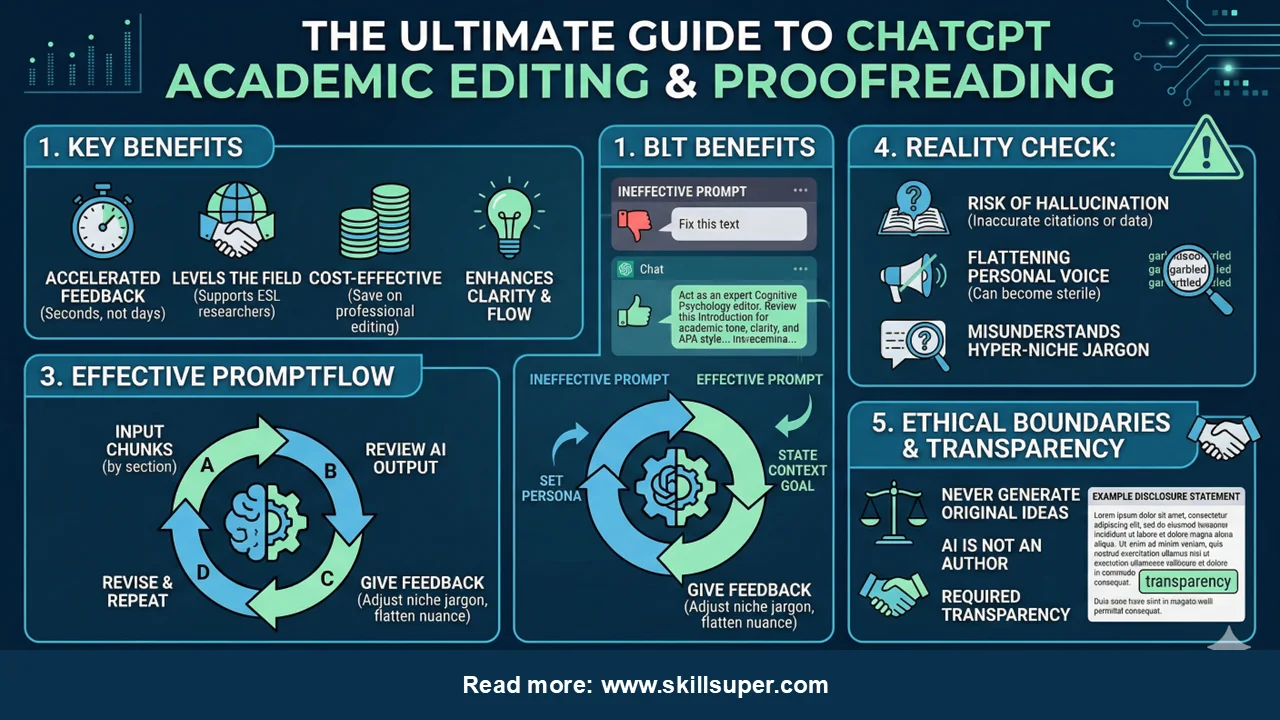
The traditional peer-review and publication cycle is agonizingly slow. Researchers cannot afford to lose weeks waiting for a human editor to return a manuscript. ChatGPT can review a 5,000-word article in a matter of seconds. It can instantly highlight repetitive words, correct subject-verb agreement errors, and suggest structural improvements. This rapid feedback loop allows scholars to iterate on their drafts continuously, accelerating the path from a rough draft to a polished submission.
- Leveling the Playing Field for Non-Native English Speakers (ESL)
Perhaps the most profound impact of using ChatGPT for academic editing and proofreading is its democratization of academic publishing. Science and research are global endeavors, yet the vast majority of high-impact journals publish exclusively in English.
For ESL (English as a Second Language) researchers, this creates an enormous barrier. A brilliantly designed study might be rejected during peer review simply due to awkward phrasing or non-standard grammar. ChatGPT acts as a tireless, judgment-free language partner. It can translate direct translations into natural, idiomatic academic English, ensuring that a researcher’s findings are judged on their scientific merit, not their linguistic background.
- Cost-Effectiveness for Underfunded Researchers
Professional academic editing services are incredibly valuable, but they are also expensive. Rates can easily range from hundreds to thousands of dollars per manuscript. For graduate students, independent researchers, or scholars working in underfunded departments, these costs are often prohibitive. ChatGPT provides a free or highly affordable alternative (via premium tiers) that performs high-level proofreading, allowing researchers to allocate their limited grants toward actual research rather than administrative costs.
- Enhancing Flow, Cohesion, and Readability
Academic writing often suffers from the “curse of knowledge.” Researchers are so deeply embedded in their subject matter that they write dense, convoluted sentences that are difficult for interdisciplinary readers to parse. By using ChatGPT for academic editing and proofreading, you can ask the AI to “simplify this paragraph for clarity” or “improve the transition between these two ideas.” The model excels at restructuring passive, bloated sentences into active, engaging prose without losing the underlying scientific meaning.
Actionable Strategies: How to Effectively Use ChatGPT as Your Academic Editor
If you want to achieve professional-grade results, you cannot simply paste your entire thesis into the chatbox and type “fix this.” Getting the best out of AI requires “prompt engineering”—the art of giving the machine specific, context-rich instructions.
Here is a step-by-step methodology for using ChatGPT for academic editing and proofreading effectively.
Step 1: Assign a Persona and Set the Context
ChatGPT performs best when it knows exactly what role it is playing. Before providing your text, prime the AI with a detailed prompt that outlines its persona, your target audience, and the specific field of study.
Example Prompt:
“Act as an expert academic editor specializing in [Your Field, e.g., Cognitive Psychology]. I am going to provide you with the introduction section of my manuscript, which is intended for submission to [Target Journal]. Your goal is to review the text for clarity, academic tone, and grammatical accuracy. Do not alter the core scientific findings or data.”
Step 2: Edit in Manageable Chunks
LLMs have context windows—a limit on how much text they can “remember” and process accurately at one time. While newer models can handle larger documents, you will generally get much more meticulous editing if you feed the manuscript section by section (e.g., Abstract, Introduction, Methods, Results, Discussion).
Step 3: Target Specific Editing Needs
Instead of asking for a general rewrite, use targeted prompts to address your specific weaknesses.
- For Grammar and Proofreading: “Please proofread the following text for spelling, punctuation, and grammatical errors. Highlight the changes you made.”
- For Flow and Transitions: “The transition between paragraph two and paragraph three feels abrupt. Please suggest three different ways to smoothly connect the idea of [Concept A] to [Concept B].”
- For Conciseness: “This section is over the journal’s word limit. Please edit this text to be 20% shorter while retaining all key arguments, citations, and data points.”
- For Tone Adjustment: “Elevate the vocabulary in this paragraph to match a formal, peer-reviewed academic tone.”
Step 4: The Iterative Review Process
Never accept ChatGPT’s first output blindly. Read through the suggested changes. If the AI misunderstood a technical term or flattened the nuance of your argument, correct it.
Example Prompt:
“Your revision was good, but you changed the meaning of [Specific Jargon]. In this context, [Specific Jargon] means [Definition]. Please rewrite the paragraph keeping this specific meaning intact.”
The Reality Check: Limitations and Risks of AI Proofreading
While using ChatGPT for academic editing and proofreading is highly advantageous, it is not a silver bullet. Grounding your expectations in reality is crucial to avoid potentially disastrous academic missteps.
- The Risk of “Hallucinations” and Factual Errors
ChatGPT is a text predictor, not a truth-teller. If you ask it to expand on an idea or rewrite a paragraph, it may occasionally “hallucinate”—inventing facts, citing non-existent papers, or making logical leaps that are scientifically inaccurate. When you use AI for editing, you must meticulously fact-check every single output. If the AI rewrites a sentence explaining your methodology, you must verify that the new sentence accurately reflects what you actually did in the lab.
- Flattening of Nuance and Personal Voice
Every researcher has a unique academic voice. Over-relying on ChatGPT can result in text that is grammatically flawless but stylistically sterile. The AI tends to favor safe, predictable sentence structures. If you let it rewrite your entire paper, your manuscript might lose the passionate, argumentative edge that makes your research compelling. It is vital to use AI as an assistant, not an author, ensuring your unique perspective remains central.
- Misunderstanding Hyper-Niche Jargon
While ChatGPT has ingested a massive amount of academic data, its knowledge is generalized. If you are working on the absolute bleeding edge of a highly specialized field (e.g., a sub-branch of synthetic biology or a niche area of medieval linguistics), the AI may not fully grasp the context of newly coined terms. It might attempt to “correct” valid technical jargon into common—but incorrect—layman’s terms.
The Elephant in the Room: Ethics, Plagiarism, and Journal Policies
As the use of AI tools skyrockets, academic institutions and publishers are scrambling to establish ethical guidelines. A critical component of using ChatGPT for academic editing and proofreading is understanding where the ethical boundaries lie.
Is AI Editing Considered Plagiarism?
Generally, using a tool to check grammar, improve sentence flow, or suggest synonyms is not considered plagiarism. It is conceptually similar to using Grammarly or a human proofreader. However, if you use ChatGPT to generate original ideas, synthesize literature you haven’t read, or write entire sections of your paper from scratch, you are crossing into academic misconduct.
Navigating Journal Policies and Disclosures
The academic publishing world has reached a general consensus: AI cannot be listed as an author. An author must be capable of taking legal and ethical responsibility for a paper, which a machine cannot do.
Major publishers like Nature, Elsevier, and Science have updated their editorial policies regarding AI. Most of them explicitly allow the use of LLMs to improve the readability and language of a manuscript. However, they universally require transparency.
If you are using ChatGPT for academic editing and proofreading, you must disclose this in your methodology section or acknowledgments. A simple disclosure might read:
“During the preparation of this work, the author(s) used ChatGPT (Model version X) in order to improve the grammatical accuracy and readability of the manuscript. After using this tool/service, the author(s) reviewed and edited the content as needed and take full responsibility for the content of the publication.”
Always check the specific author guidelines of your target journal before submission, as policies are evolving rapidly.
Striking the Balance: The Hybrid Approach to Academic Editing
So, will AI replace human academic editors entirely? Not anytime soon. The ideal workflow for modern scholars is a hybrid approach that leverages the strengths of both machine and human.
ChatGPT is unparalleled for the “heavy lifting” of early-stage drafting. It is the perfect tool for your first, second, and third drafts. It will catch your typos, fix your comma splices, help you meet your word counts, and translate your rough thoughts into coherent academic prose.
However, for high-stakes submissions—such as a doctoral dissertation, a grant proposal for significant funding, or a submission to a top-tier journal—the human element remains irreplaceable. A human subject-matter expert editor can do what AI cannot: they can challenge your underlying logic, spot theoretical gaps in your argument, ensure your narrative arc makes sense to a human reader, and verify that your tone aligns perfectly with the unspoken cultural expectations of your specific academic niche.
Conclusion
The integration of artificial intelligence into scholarly writing is a permanent shift. By using ChatGPT for academic editing and proofreading, researchers can dramatically reduce the friction of the writing process, overcome language barriers, and produce clearer, more impactful manuscripts.
However, this powerful tool demands responsible usage. It requires researchers to act as vigilant directors, crafting precise prompts, rigorously fact-checking outputs, and maintaining complete transparency with publishers.
Ultimately, ChatGPT is not a replacement for rigorous scientific thought or academic integrity. It is simply a highly advanced lens through which your research can be brought into sharper focus. Embrace it as an assistant and let it empower you to share your findings with the world more effectively than ever before.
