
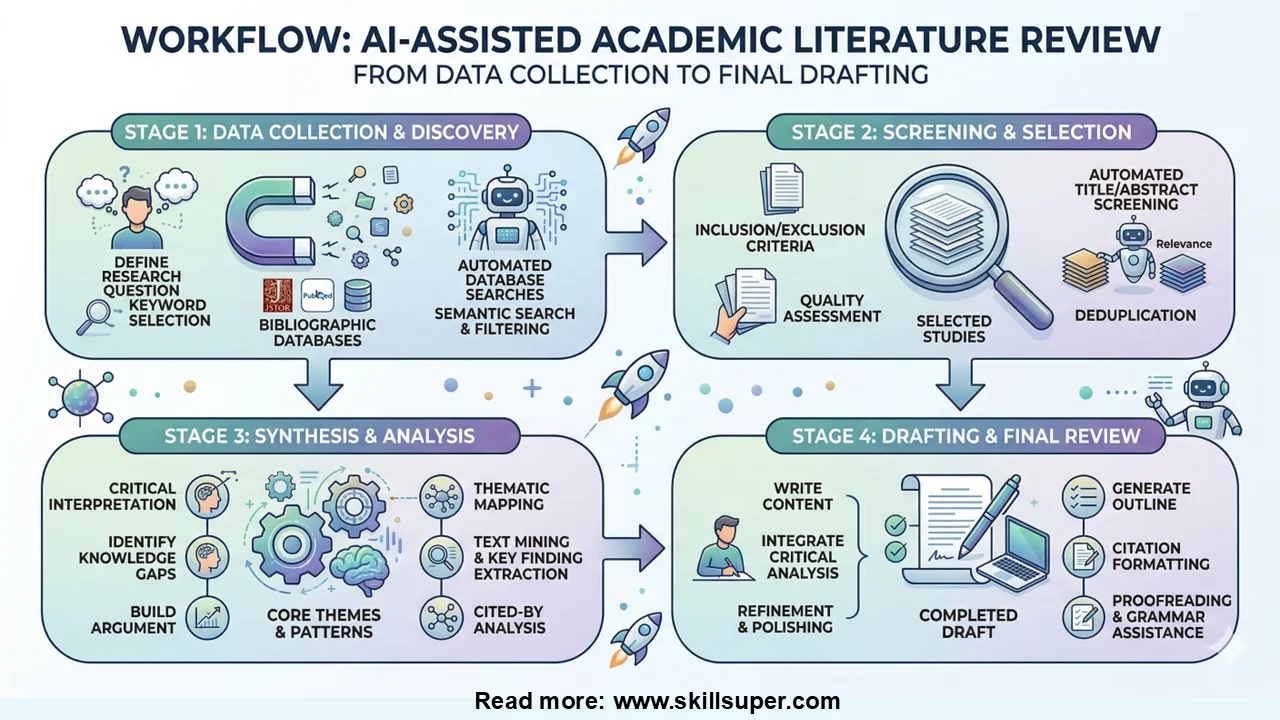
7 Powerful Strategies for Executing AI-Assisted Academic Literature Reviews
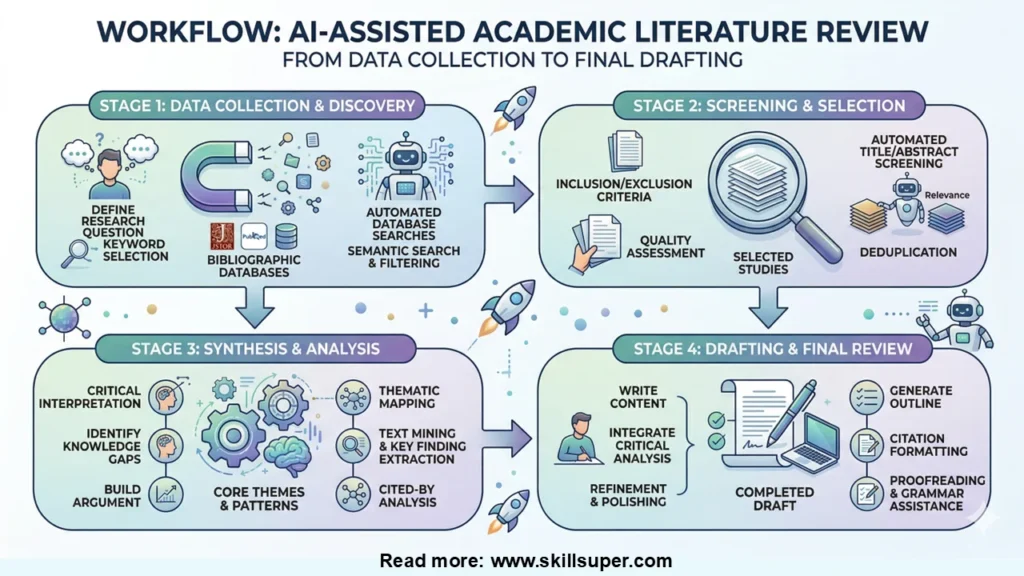
To truly benefit from this technology, you need a systematic approach. Here are seven actionable strategies to integrate AI into your research workflow today.
- Brainstorm and Define Your Scope with AI
Before diving into databases, you need a tight research question. AI is an excellent sounding board for this crucial first step.
You can feed an AI model your initial, messy thoughts. For example, tell the AI, “I want to research the impact of urban noise pollution on cognitive development in adolescents, but I need to narrow this down.” The AI will instantly generate sub-topics, suggest alternative variables, and help you refine a vague interest into a precise, searchable research question.
Use AI to generate a list of primary, secondary, and tertiary keywords to use across different academic databases. This ensures you do not miss vital literature simply because an author used a different terminology than you did.
- Deploy Specialized AI Research Assistants
Generic chatbots are helpful for brainstorming, but for the heavy lifting of AI-assisted academic literature reviews, you must use specialized platforms built specifically for science and academia.
Tools like Elicit, Consensus, and SciSpace access databases of peer-reviewed literature. When you ask Elicit a question, it does not just generate an answer based on its training data; it pulls actual papers, summarizes their abstracts, and creates a matrix of the top research answering your specific query.
These platforms drastically reduce the risk of “hallucinations” (AI making up facts) because their outputs are strictly grounded in published, verifiable literature.
- Accelerate Screening and Abstract Reading
The screening phase of a systematic review is notoriously tedious. You gather thousands of papers and must determine which ones actually fit your criteria.
AI-assisted academic literature reviews streamline this flawlessly. You can upload your initial batch of PDFs to tools like ChatPDF or specialized systematic review software. You then prompt the tool with strict parameters: “Scan these documents and identify only the papers that use a randomized controlled trial methodology and feature a sample size larger than 100.”
The AI instantly filters the stack, leaving you with a highly targeted reading list. You still verify the results, but the initial sorting takes a fraction of the time.
- Map the Research Landscape with Citation Networks
Understanding how papers connect to one another is vital. Who are the foundational authors? Which papers contradict each other?
Visual AI mapping tools like ResearchRabbit or Connected Papers are absolute game-changers for this. You input a single “seed” paper that you know is highly relevant to your topic. The AI then generates a visual web, branching out to show you earlier foundational papers (references) and later papers that cited your seed paper (derivatives).
This visual approach ensures you identify the core canonical texts of your field, alongside the most cutting-edge recent publications, preventing any glaring omissions in your bibliography.
- Extract and Synthesize Complex Data Accurately
Once you narrow down your reading list, you need to extract the data. Traditionally, this meant keeping a massive, unwieldy Excel spreadsheet open on a second monitor while you frantically typed in methodologies and outcomes.
Modern AI tools allow you to build custom extraction tables. You can command the AI to read 20 selected papers and output a table detailing the authors, year, geographic location of the study, specific interventions used, and the main findings.
This macro-level view allows you to spot trends and inconsistencies across the literature almost instantly. You can easily see where researchers disagree, which highlights the exact “gap in the literature” your own paper can fill.
- Draft the Thematic Narrative
A high-quality literature review is not just a chronological list of papers; it is a thematic narrative. Once you extract your data, you must group the research into logical categories.
You can feed your notes and synthesized tables into an LLM and ask for an outline. Prompt the AI: “Based on these notes, propose three different thematic structures for my literature review.” The AI might suggest structuring it chronologically, methodologically, or by theoretical framework.
Use the AI to help you draft transition sentences or summarize complex concepts for your introduction. Crucially, never let the AI write the final analysis. You use the generated text as a rough clay model, which you then sculpt, refine, and rewrite in your own academic voice.
- Fact-Check and Verify Citations with AI
The final, and perhaps most important, strategy involves using AI to double-check your work. AI-assisted academic literature reviews require rigorous verification.
Tools like Scite.ai use “Smart Citations” to show you exactly how a paper has been cited by others. It tells you whether the subsequent papers supported, mentioned, or contrasted with the original findings.
Before you finalize your review, run your core citations through a tool like this. It ensures you have not accidentally cited a retracted paper, or built a major argument on a study that the wider academic community subsequently debunked.
The Ethical Pitfalls: What AI Cannot (and Should Not) Do
While AI-assisted academic literature reviews offer immense power, researchers must navigate significant ethical pitfalls. Transparency and academic integrity must remain your top priorities.
First, never use AI to generate raw citations. General-purpose LLMs are notorious for hallucinating fake papers, complete with plausible-sounding authors and DOIs. If you include a fake citation in your review, you severely damage your academic reputation. Always trace every claim back to the original source.
Second, beware of inherent biases. AI models train on existing literature, which means they reproduce the historical biases present in academia. They may over-represent research from Western, English-speaking institutions while ignoring valuable global perspectives. You must actively seek out diverse research to counteract this algorithmic blind spot.
Finally, you are ultimately responsible for the work. You cannot blame an AI tool if your methodology is flawed or your conclusions are incorrect. AI is a tool, exactly like a calculator or statistical software. The intellectual ownership, and the associated accountability, rests entirely on your shoulders. Check your institution or target journal’s specific guidelines regarding AI disclosure; many now require a brief statement explaining how you used AI tools during your research process.
The Future of Academic Research
The integration of artificial intelligence into academia is not a passing trend; it is a fundamental paradigm shift. As these models become more sophisticated, the barriers to deep, interdisciplinary research will continue to fall.
Future iterations of AI tools will likely offer real-time peer review simulation, helping you identify logical fallacies in your arguments before you even submit your manuscript. They will seamlessly translate and synthesize research across dozens of languages, truly globalizing the scientific conversation.
However, the core of academia will remain deeply human. The curiosity to ask the right questions, the empathy to understand the societal impact of the data, and the intuition to leap beyond what is already known—these are qualities algorithms cannot replicate.
By mastering AI-assisted academic literature reviews today, you do not just save time. You elevate the quality of your scholarship, equipping yourself with the ultimate toolkit to push the boundaries of human knowledge further and faster than ever before. Embrace the tools, respect the limitations, and get back to doing the deeply human work of discovery.
