
10 Essential Strategies for Mastering ChatGPT in Academic Publications
In the rapidly evolving landscape of 2026, the question is no longer if researchers should use artificial intelligence, but how they can do so with integrity. The emergence of ChatGPT and more advanced reasoning models like GPT-5.2 has fundamentally shifted the academic paradigm. What was once viewed with skepticism in 2023 is now a sophisticated component of the modern researcher’s toolkit.
Navigating the intersection of ChatGPT in academic publications requires a delicate balance between leveraging efficiency and maintaining rigorous scholarly standards. This guide provides a comprehensive roadmap for researchers, editors, and students looking to master AI-assisted writing while staying compliant with the latest 2026 journal policies.
The Evolution of ChatGPT in Academia: From Taboo to Tool
The journey of Large Language Models (LLMs) in research has been transformative. Early on, the academic community feared a “plagiarism pandemic.” However, as of April 2026, the conversation has matured into a focus on “AI literacy” and “transparent collaboration.”
Major institutions now recognize that ChatGPT is a powerful “scientific collaborator.” It assists in synthesizing vast literatures, debugging complex code, and refining the linguistic clarity of manuscripts. The key shift has been moving from using AI as a ghostwriter to using it as an advanced cognitive assistant.
Current Landscape: What Major Journals Say in 2026
Before you integrate AI into your workflow, you must understand the rules of the game. Most high-impact journals have converged on a set of core principles regarding ChatGPT in academic publications.
Nature, Science, and Elsevier Policies
In 2026, the “Big Three” publishers—Nature Portfolio, Science (AAAS), and Elsevier—share three non-negotiable pillars:
- AI Cannot Be an Author: LLMs lack the legal standing and accountability to be credited as authors.
- Mandatory Disclosure: You must explicitly state how, where, and why AI was used.
- Human Accountability: The human authors are 100% responsible for every claim, citation, and figure in the paper.
| Publisher | AI for Writing | AI for Figures | Disclosure Location |
| Nature | Allowed with disclosure | Highly restricted | Methods or Acknowledgments |
| Science | Allowed with disclosure | Prohibited for primary data | Methods Section |
| Elsevier | Allowed with disclosure | Restricted | Dedicated AI Declaration |
| IEEE | Editing only | Prohibited | Separate AI Statement |
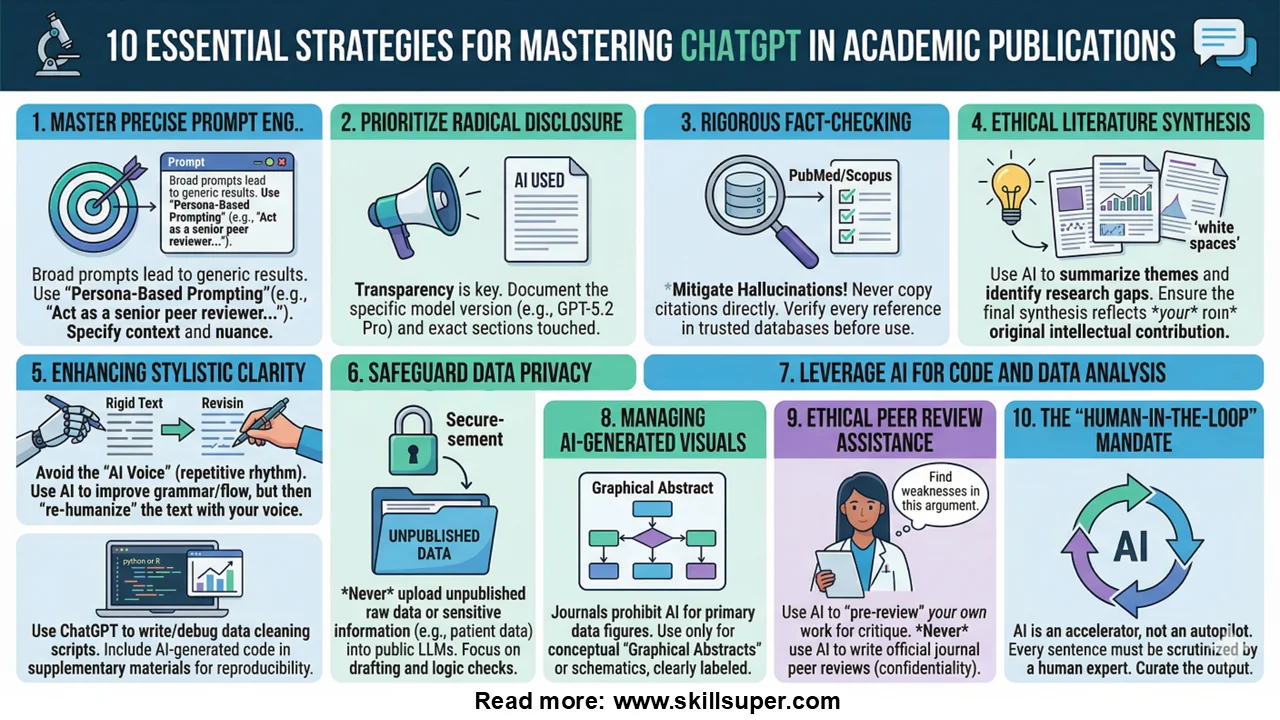
10 Essential Strategies for Mastering ChatGPT in Academic Publications
To excel in the current research environment, you need a strategic approach to AI integration. Here are the ten most effective strategies for using ChatGPT ethically and efficiently.
- Master Precise Prompt Engineering
Broad prompts lead to generic, often inaccurate results. To get the most out of ChatGPT, use “Persona-Based Prompting.” Instead of saying “summarize this,” try:
“Act as a senior peer reviewer in molecular biology. Summarize the following findings, highlighting potential gaps in the experimental design.”
This level of specificity forces the model to focus on the nuances that matter in a professional academic context.
- Prioritize Radical Disclosure
Transparency is your greatest defense against allegations of misconduct. In 2026, a simple “AI was used” is no longer enough. You should document the specific version of the model (e.g., ChatGPT GPT-5.2 Pro) and the exact sections it touched.
- Rigorous Fact-Checking and Hallucination Mitigation
Despite advancements, LLMs can still “hallucinate” facts or invent citations. Never copy a reference directly from ChatGPT without verifying it in a trusted database like PubMed, Scopus, or Web of Science. Use AI to find connections, but use your expertise to verify them.
- Ethical Literature Synthesis
ChatGPT is excellent at summarizing themes across dozens of papers. Use it to identify “white spaces” in current research. However, ensure that the final synthesis reflects your original intellectual contribution. The AI should help you map the territory, but you must choose the path.
- Enhancing Stylistic Clarity (Avoiding the “AI Voice”)
AI-generated text often has a recognizable, repetitive rhythm. Use ChatGPT to fix grammatical errors or improve flow, but then “re-humanize” the text. Break up long sentences, add personal insights, and ensure the tone aligns with your previous body of work.
- Safeguard Data Privacy
Never upload unpublished raw data or sensitive patient information into a public LLM. Even with “Enterprise” versions, the risk of data leakage remains a concern for many institutional review boards (IRBs). Stick to using AI for drafting, logic checks, and literature reviews rather than processing proprietary datasets.
- Leverage AI for Code and Data Analysis
One of the most powerful uses of ChatGPT in 2026 is its ability to write and debug Python or R scripts. It can help you automate data cleaning or suggest the best statistical models for your hypothesis. Always include your AI-generated code in your supplementary materials for reproducibility.
- Managing AI-Generated Visuals
The rules for images are stricter than for text. Most journals prohibit AI-generated figures that represent primary data. However, you can use tools like DALL-E 3 (integrated into ChatGPT) to create conceptual “Graphical Abstracts” or schematic diagrams, provided they are clearly labeled.
- Ethical Peer Review Assistance
Many researchers use AI to “pre-review” their own work. By asking ChatGPT to “find the weaknesses in this argument,” you can address potential critiques before submission. However, never use AI to write a review for a paper you are officially peer-reviewing for a journal, as this violates confidentiality agreements.
- The “Human-in-the-Loop” Mandate
The final strategy is a mindset: always keep a “human-in-the-loop.” AI is an accelerator, not an autopilot. Every sentence generated by an AI must be scrutinized by a human expert. In 2026, the mark of a great researcher is not how well they use AI, but how well they curate the AI’s output.
The Legal Framework: EU AI Act and Article 50
In 2026, the legal landscape has caught up with the technology. The EU AI Act, specifically Article 50, now mandates that AI-generated content must be detectable. This has led to the widespread adoption of “digital watermarking” (such as SynthID).
When you use ChatGPT for academic publications, the output may contain metadata that identifies it as AI-generated. Journals are increasingly using “AI Forensic” tools to scan for these watermarks. If you haven’t disclosed your use of AI, these tools will flag your submission, potentially leading to immediate rejection or “desk-side” investigations.
How to Disclose ChatGPT Use: A Step-by-Step Template
If you are preparing a manuscript today, here is a template you can adapt for your Methods section or Acknowledgments:
Declaration of AI-Assisted Technologies in the Writing Process
During the preparation of this manuscript, the authors used ChatGPT (OpenAI, Version GPT-5.2 Pro) to [list tasks, e.g., improve the linguistic flow of the Discussion section and summarize literature related to X]. After using this tool, the authors reviewed and edited the content as needed and take full responsibility for the final version of the manuscript.
Future Outlook: The Rise of “Agentic” AI Scientists
As we look toward 2027 and beyond, the trend is moving toward “Agentic AI.” These are systems that don’t just chat, but can autonomously perform literature searches, run simulations, and suggest new experimental directions.
Nature’s recent editorial on “AI Scientists” suggests that we are entering a new “acceleration phase” of discovery. While the tools will become more powerful, the core value of the academic publication—the human verification of truth—will remain the gold standard.
Conclusion
Mastering ChatGPT in academic publications is about more than just typing prompts; it’s about upholding the integrity of the scientific record in a digital age. By following these 10 strategies, you can harness the incredible power of AI to boost your productivity while remaining a responsible and ethical member of the global research community.
The future of research is collaborative. It is a partnership between human intuition and machine intelligence. Embrace the tool, but never relinquish the responsibility.
